

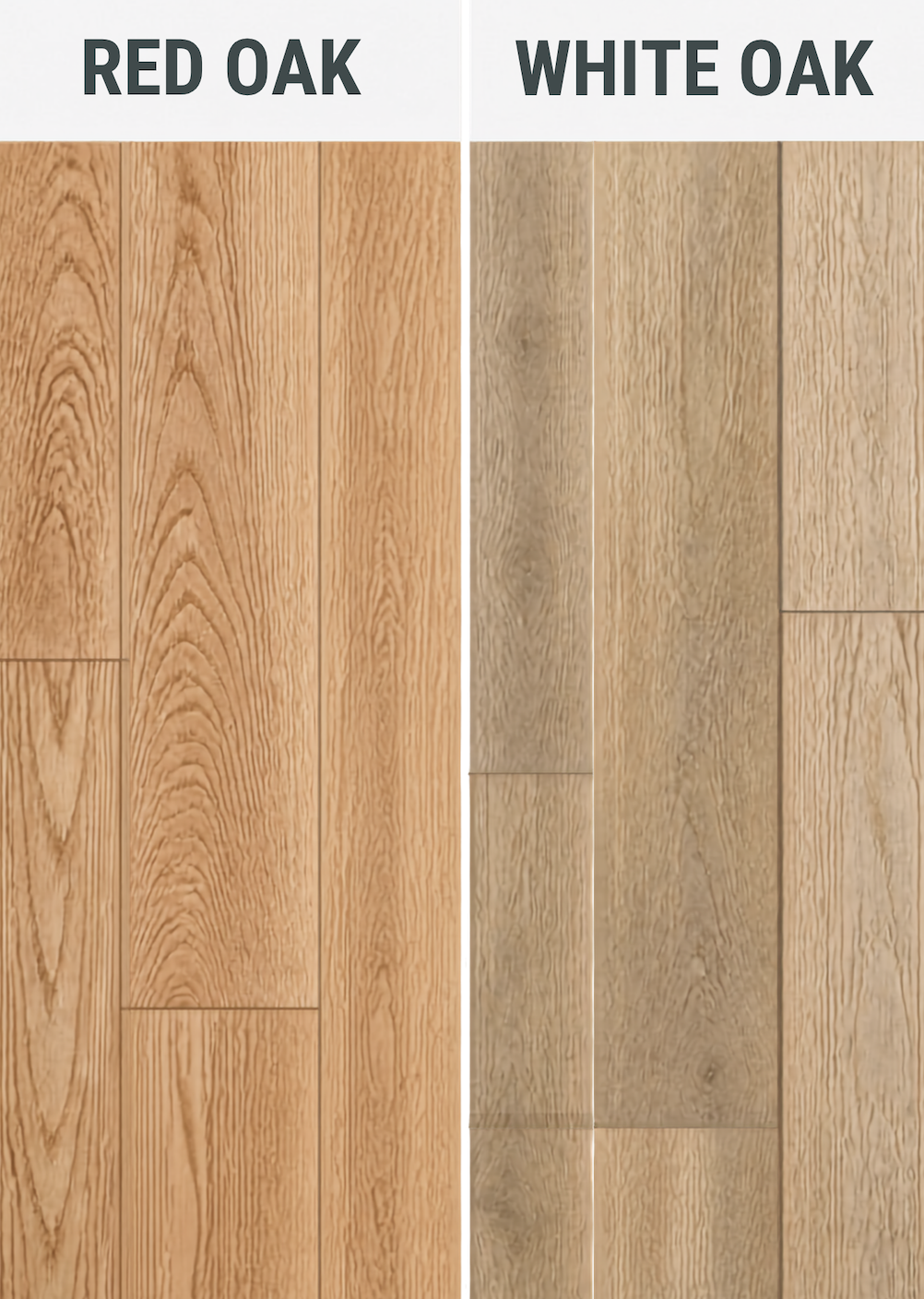
Red oak and white oak are both first-rate floors, and they sit closer together than most people assume. On the Janka scale the industry uses to rank hardness, they land only about a tenth apart, so the decision between them rarely turns on which one is tougher. What actually separates them is how each handles water, the undertone each brings to a room, and the way each takes a stain. Get those three right and either oak will give you a floor that lasts for generations. Both are staples of the hardwood our crews install and refinish across the DMV, so the choice is about the wood itself.
Which Oak Is Harder, Red or White?
White oak is harder than red oak, but only by a little. Hardness in wood flooring is measured by the Janka test, which presses a steel ball just under half an inch across, 0.444 inches, into the board and records the pounds of force needed to sink it halfway in. Red oak comes in at 1,220 pounds and white oak at 1,350 pounds on the Janka scale, so white oak is about 130 points, or a tenth, harder. White oak's also a shade denser, around 0.75 to red oak's 0.70 on the specific-gravity scale wood scientists use to compare density, which is part of why it feels a touch more solid underfoot. In a house, though, that hardness gap is real but small. Both oaks shrug off the dents and scuffs of family life, and neither one's going to survive a dropped cast-iron pan without a mark. If you're choosing between them on hardness alone, you're splitting hairs.
Why White Oak Handles Water Better Than Red Oak
White oak resists water far better than red oak, and the reason is in the grain. Oak is a ring-porous wood, which means it grows long open vessels that run the length of the board like microscopic straws. In white oak those vessels are plugged with tyloses, tiny bubble-like growths that seal the pores shut. In red oak they stay open, so open that you can blow air through a short piece end to end. That sealed structure is why white oak has been the wood of choice for whiskey barrels and boat planking for centuries, and why it holds up better in a kitchen, an entry, or a powder room where water finds the floor. Red oak wicks up a spill through those open pores; white oak turns most of it away.
Color and Grain: How Each Oak Takes a Stain
Red oak and white oak start from different undertones, and that undertone decides how a stain reads. Red oak carries a warm, pink-to-reddish cast and a bold, swirling grain that shows through most finishes. White oak leans brown with a hint of gray-green, and its grain runs straighter and calmer. Put a modern gray, greige, or whitewashed stain on red oak and the pink tends to fight it, pushing the color muddy or slightly mauve. The same stain on white oak lands clean, which is most of the reason designers reach for white oak when the look is light and contemporary. If you want a warm honey tone or a rich walnut brown, red oak takes it beautifully, and it costs less doing it.
Red Oak vs. White Oak at a Glance
Property | Red oak | White oak |
|---|---|---|
Janka hardness | 1,220 lbf | 1,350 lbf |
Pore structure | Open, ring-porous | Sealed by tyloses |
Water resistance | Lower; absorbs spills | Higher; turns water away |
Undertone | Warm, pink to red | Brown with gray-green |
Gray and modern stains | Reads warm or muddy | Clean and even |
Best rooms | Bedrooms, living areas | Kitchens, entries, baths |
Relative cost | Lower | Higher |
Which Oak Is Right for Your Room?
Choose red oak when you want warmth, a strong grain, and a lower price, and when the room stays dry. Red oak is the classic American floor for a reason: it looks right in a bedroom, a living room, or a hallway, it takes warm stains without a fight, and it stretches a budget further across a big square footage. Its busy grain even hides small scratches a shade better than a smooth, pale floor does, and you can compare warm and cool oak tones side by side in the hardwood we stock.
Choose white oak when the room sees water, when you want a light or gray-toned stain, or when you simply prefer the calmer grain. White oak earns its higher price in a kitchen or an entry, where its sealed pores fend off the spills and tracked-in slush that would work into red oak. It is also the safer pick for the wide, pale planks that read as current right now. The trade-off is cost, and across a whole main floor that gap adds up.
Does the DMV's Climate Change the Choice?
The DMV's humidity swing matters more than the choice between the two oaks. Summers here run warm and damp, winters run dry with the furnace going, and solid oak of either kind moves with that swing, swelling as it takes on moisture in August and shrinking as it gives it back in January. The National Wood Flooring Association (NWFA), the trade group that writes the U.S. standards for wood floors, points homeowners at a steady indoor climate of 60 to 80 degrees and 30 to 50 percent relative humidity. Hold the house in that band and seasonal gaps stay hairline; let the winter air go bone dry and the boards can gap or split. We walk through why that happens in our guide to humidity and hardwood gaps.
Here's a twist worth knowing if you're weighing the two oaks on stability. Both move a good deal for a domestic hardwood, shrinking roughly 14 to 16 percent by volume as green wood dries, and white oak actually moves a little more overall than red oak. What keeps white oak looking steadier is a lower tangential-to-radial ratio, about 1.9 against red oak's 2.2. That's the number that predicts how unevenly a board distorts, or cups, rather than shrinking evenly, so white oak tends to cup a bit less even though it shrinks a bit more. In a finished, climate-controlled floor the gap is small, but it's a useful corrective to the assumption that the more water-resistant oak must also be the steadier one.
Below grade, neither solid oak belongs. A basement or a concrete slab holds and releases moisture in a way solid wood can't ride out, so that's where an engineered oak floor comes in, a real oak wear layer bonded to a plywood core that stays put over concrete. If that wear layer is thick enough, the 2.5 to 3.2 millimeters the NWFA sets for a refinishable floor, a good engineered oak can even be sanded and refinished later, the same as solid. Which construction your rooms call for depends on what sits under them, and it's the first thing our crews check before a single board goes down.
Common Questions About Red and White Oak
Is white oak worth the extra cost over red oak?
White oak is worth it when the room sees water or you want a light, modern stain, and less so when it does not. In a kitchen, an entry, or a bathroom, white oak's sealed pores earn the premium by keeping spills off the wood. For a dry bedroom finished in a warm tone, red oak does the same job for less. The two are close enough in hardness, 1,220 versus 1,350 on the Janka scale, that durability by itself does not justify the difference.
Can you stain red oak to look like white oak?
You can get red oak close to a white oak tone, but the pink undertone usually shows through a cool stain. A skilled finisher can knock the red back with a toner or a two-step stain, and on a warm color the difference nearly disappears. On a true gray or whitewash, red oak tends to read warmer or muddier than white oak would, which is why the light, contemporary looks almost always start with white oak.
Which oak holds up better in a kitchen?
White oak holds up better in a kitchen because its pores are sealed against water. Red oak's open grain wicks up spills and cleaning water, which over time can darken and swell the boards near the sink and the dishwasher. If your heart is set on red oak in a kitchen, a tough finish and quick spill cleanup help, but white oak starts ahead. For a floor that will see standing water, an engineered wood or a water-resistant surface is the more forgiving route.
Does red oak or white oak scratch more easily?
Red oak and white oak scratch about the same, because they're within ten percent of each other on the hardness scale. What changes how visible a scratch is has more to do with the finish and the grain than the species: a busy red oak grain under a low-sheen finish hides scuffs, while pale white oak under a glossier finish shows them. Neither oak is scratch-proof, and in a house with dogs or kids a matte finish does more for you than the choice between the two woods.
Choosing the Right Oak for Your Home
The honest short version: red oak for warmth, budget, and dry rooms; white oak for water, cool stains, and a calmer grain. Both will still be under your feet decades from now, so the bigger risk is picking a wood that fights the look you are after, and that is the easy part to get right with a sample in hand. When you want to see the two side by side and talk through which suits your rooms and your subfloor, request a free estimate and we will bring samples to your home and measure the space.


