

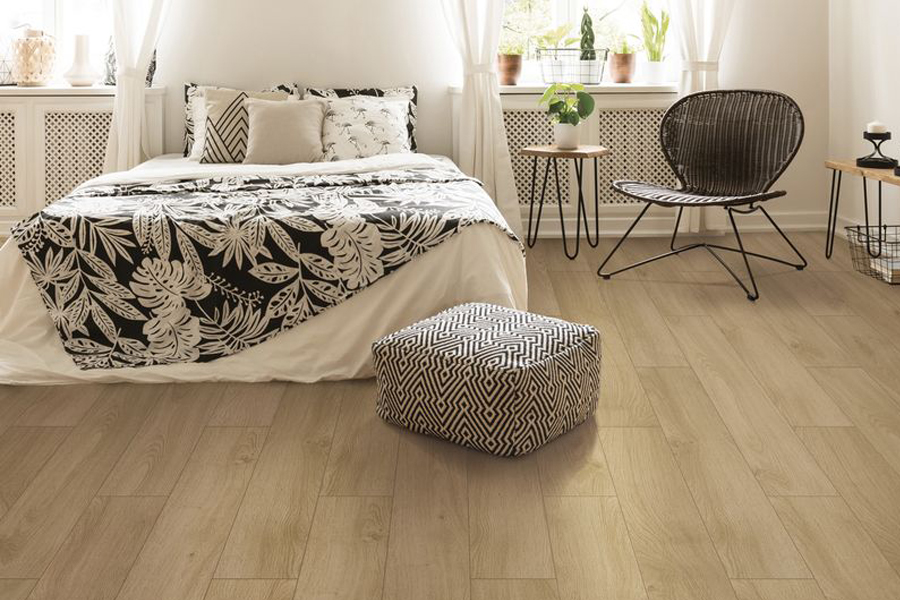
If you are replacing floors in a busy household in Waldorf, laminate can look straightforward until you start comparing specs. One carton says AC3, another says AC4, and a third jumps to AC5 with a higher price tag. The challenge is knowing which rating actually matters for your home and which one is just more durability than you need.
What an AC Rating Actually Measures
AC stands for Abrasion Class, a scale used to describe how well a laminate floor’s wear layer stands up to scratching, scuffing, impact, and everyday traffic. In simple terms, it helps you compare how hard a floor can work before it starts to show wear. If you want a broader primer on construction, visuals, and performance, our laminate flooring guide gives the bigger picture.
Most homeowners will run into a few common levels. AC1 and AC2 are light-duty ratings and are rarely the best fit for active homes. AC3 is often appropriate for bedrooms, home offices, and lower-traffic living spaces, while AC4 is usually the sweet spot for main living areas, hallways, kitchens, and homes with kids or pets. AC5 moves into heavier commercial territory, which can be useful, but it is not automatically the smartest buy for every room.
How to Match the Rating to Real Life
The right rating depends less on marketing language and more on how the room is used. A quiet guest room does not need the same surface strength as an entry corridor where grit, dog nails, and wet shoes show up every day. That is why we usually tell homeowners to start with their traffic patterns, not the highest number on the label.
For many households, AC4 offers the best balance of cost and durability. It gives you more protection in the spaces where chairs slide, bags drop, and people cut through all day, without pushing you into a product category designed for storefront-level wear. If you are comparing visuals and performance levels side by side, our laminate catalog is a practical place to narrow the field.
Brand construction matters too. Two laminate floors with similar ratings can still feel different underfoot or vary in edge detail, plank realism, and locking strength. Homeowners who want stronger scratch resistance with convincing wood visuals often start by looking at Mohawk laminate, especially for busy family spaces.
AC Ratings Are Only Part of the Story
A higher rating does not fix poor installation or a weak subfloor. If the surface underneath is uneven, even a durable plank can flex, separate, or sound hollow over time. That is why performance depends on the whole system, from product selection to prep work and final fit.
Moisture exposure matters too, especially in parts of Prince George's County where concrete slabs and seasonal humidity changes can affect flooring behavior. Laminate handles daily wear well, but it still needs the right room and the right installation conditions. Our laminate installation process is different from hardwood work for exactly that reason: the subfloor, transitions, and expansion details all shape how the floor lives long term.
The Smart Buy Is the One That Fits the Room
The best laminate purchase is not the toughest product in the store. It is the one that fits your traffic level, your budget, and the way your household actually moves through the day. AC3 can be enough in quieter rooms, AC4 covers most active homes well, and AC5 is usually worth considering only when wear is unusually heavy.
If you want help sorting through ratings, plank styles, and room-by-room recommendations, we can help you compare options and plan the project with a clear next step through our free in-home estimate.


