

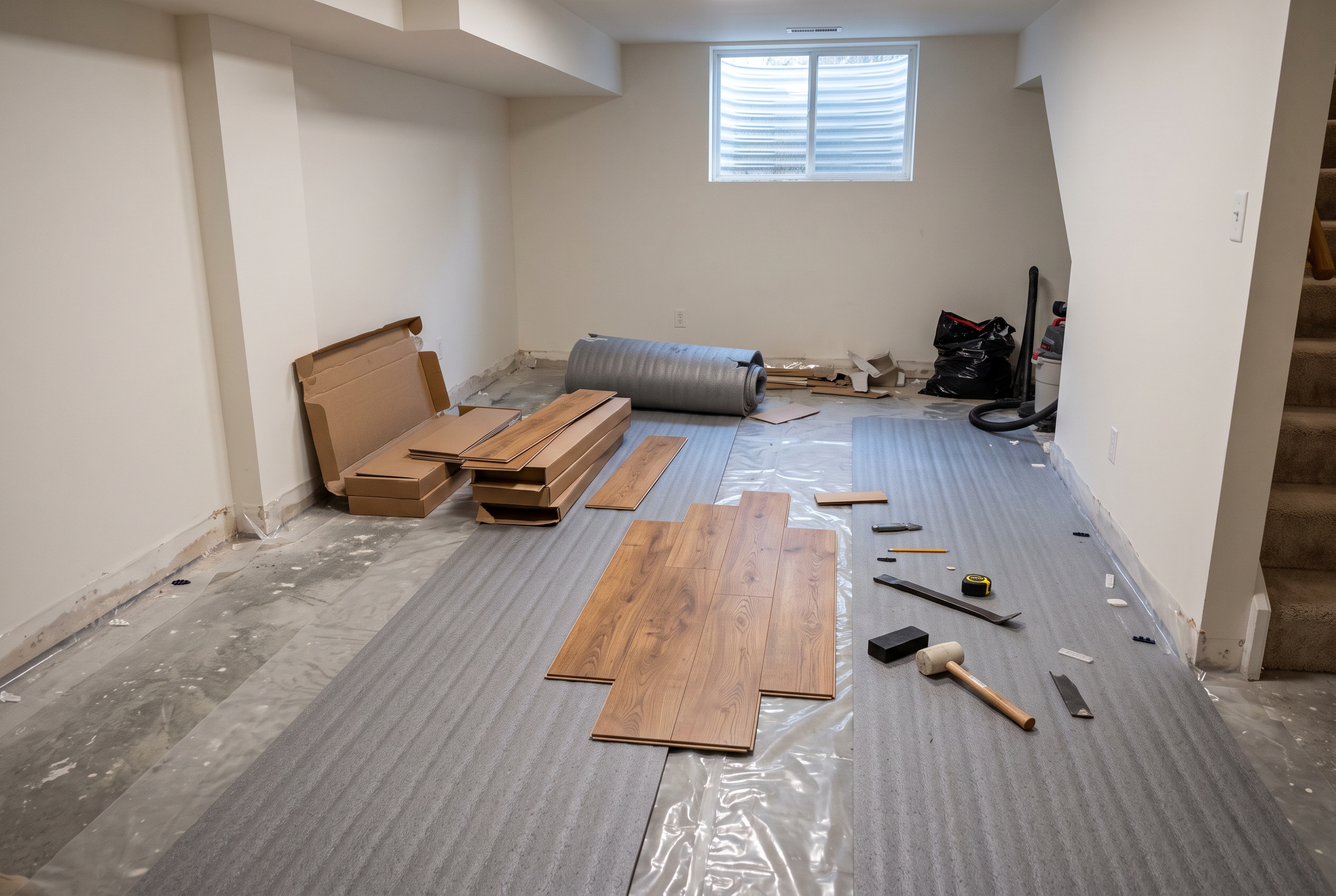
If your laminate has a pad attached to the back of each plank, you don't add another one. If it has no pad, it needs an underlayment approved for that laminate and the floor you're covering. On a concrete slab, a plastic vapor film goes down first unless the installation sheet says the pad's own film does that job. Over a wood subfloor, a plain foam or a denser felt does it, and where a neighbor lives underneath you, an acoustic pad rated for the building.
| What You're Laying Over | Planks With a Pad Attached | Planks Without a Pad |
|---|---|---|
| Concrete slab or basement | A 6 mil plastic film first | Film plus pad, or a pad with a film |
| Plywood or OSB, upper floor | Nothing more | Foam or felt, no plastic |
| Plywood over a crawlspace | Nothing more; cover the crawlspace ground | Foam or felt; cover the crawlspace ground |
| Flat, tight vinyl or tile | Nothing more (film on a slab) | An approved pad (film on a slab) |
| Carpet | Take it up | Take it up |
What Underlayment Does Under a Laminate Floor
Underlayment is the thin layer between the subfloor and a floating laminate floor, and the locking joints depend on it. It gives them an even, slightly cushioned bed, so they don't grind on grit or rock over small bumps. It also takes the hard click out of footsteps.
When it carries a film, underlayment keeps moisture rising from a slab away from the fiberboard core, and it bridges fine texture in the subfloor, like a plywood seam or a trowel mark in concrete. A laminate floor floats on that layer instead of being nailed or glued, so the pad carries much of how the finished floor feels and sounds.
What underlayment can't do matters as much. It won't level a floor with a hump or a dip, won't fix a soft or squeaky subfloor, and does nothing about water spilled on the surface, which is the plank's own job.
Do You Need Underlayment if Your Laminate Has a Pad Attached?
No, not another pad. The attached pad is the underlayment, and laying a second foam under it makes the floor ride too soft, so the joints flex every time you step and eventually open or break. Mohawk's RevWood Plus instructions, for example, call for a single layer of underlayment only under planks that don't have one attached.
On concrete, attached-pad planks still get a film. A slab gives off moisture, so a 6 mil polyethylene sheet goes down under them too, unless the installation sheet says the pad's own film replaces it. If your line's sheet names an optional pad that can go under the attached one, that specific pad is the only one to use.
The carton tells you what you have: look for "attached underlayment" or "pre-attached pad", what the pad is made of, and whether it carries a vapor barrier. The Built-in Underlayment filter in our laminate catalog shows lines with the pad already on, including Chesapeake's All American Premium and Fusion Design XL, Mohawk's Hampton Villa and Revolution Mills' Avalon.
The Kinds of Laminate Underlayment and When Each Fits
The best underlayment for laminate is one approved for your planks and your subfloor, and within that list you're choosing for moisture, sound and price. Firmness matters more than thickness: a dense pad that springs back supports the joints, while a soft, squishy one lets them flex.
| Type | Where It Fits | Watch For |
|---|---|---|
| Standard foam | Dry wood subfloors, on a budget | Least sound control; no film |
| Foam with a film | Concrete slabs and basements | Tape the film seams |
| Felt or fiber | Quieter floors over wood | Some carry a film, some don't |
| Cork | Quiet, firm, natural | Needs a separate film on concrete |
| Acoustic pads | Condos and upper floors | Check the rating against the rule |
Standard foam is the budget choice over a dry plywood floor. Foam with a built-in film, often sold as two-in-one, is the usual pick for a slab. Felt and fiber pads are denser and noticeably quieter underfoot, and cork is firm and quiet but needs its own film on concrete. Rubber pads are common under vinyl and tile; under laminate, use one only if your installation sheet allows it.
Underlayment for Laminate Over Concrete
Concrete always gets a vapor film under laminate, because every slab gives off moisture, even one that looks dry. The film is 6 mil polyethylene, laid with the seams overlapped about 8 inches and taped and run a couple of inches up the wall, or it's built into a two-in-one pad. The pad goes on top if the planks don't have one.
The slab gets tested before the floor goes down, and the limits are the makers' own. Mohawk allows up to 5 pounds of moisture per 1,000 square feet in 24 hours by the calcium chloride test, or under 80 percent relative humidity by a probe set into the slab. Mannington takes the same 5 pounds but caps the probe reading at 75 percent. A new slab needs weeks to cure before it can pass either.
Slabs are everywhere here: DMV basements, split-level family rooms and the ground floor of many townhouses. An older slab poured without a vapor barrier under it leans harder on the film on top. We test the slab for moisture before any new floor goes down, and a slab that tests too wet gets a sealer or a different floor.
Underlayment for Laminate Over Plywood or OSB
Over plywood or OSB on an upper floor, a plain foam or a felt pad is all a padless laminate needs, and no plastic film goes on top of the wood. The film is a concrete rule; on a wood floor, a sheet of plastic between the subfloor and the planks can trap moisture in the wood.
Over a crawlspace, the moisture control starts in the crawlspace itself. Mannington wants the wood floor at least 18 inches off the ground, the crawlspace ventilated, and the ground covered with a vapor barrier. The wood subfloor itself should read 12 percent moisture or less before laminate goes over it, which a moisture meter shows in seconds.
Older DMV rowhouses and colonials often have plank subfloors instead of plywood. Those get screwed down tight and checked for flatness first, and a squeak that comes with a dip or a soft spot points to loose fasteners or a flexing subfloor, which no underlayment will fix.
Underlayment When Laminate Goes Over Tile, Vinyl or Wood
A flat, firmly attached hard floor can usually stay, and the underlayment goes on top of it just as it would on a subfloor. Laminate can float over a flat, securely attached vinyl or tile floor, which saves the cost and mess of tearing it out. Mannington allows its laminate over existing vinyl, wood flooring and ceramic tile, though not over loose-lay, heavily cushioned or several layers of vinyl.
Over ceramic tile, the grout lines get leveled first so they don't show through, and on a slab the vapor film still goes down. Over old hardwood, a standard pad goes on and no film. Carpet always comes up, and old wood flooring glued to a slab comes out too.
In an older house, old vinyl tile and sheet flooring are often safer covered than torn out. The EPA counts old vinyl tile, sheet-vinyl backing and their adhesive among materials that may contain asbestos. Its advice is to leave such material undisturbed when it's in good condition. Check that the added height still clears doors and appliances.
The Best Underlayment for a Quieter Laminate Floor
The quietest laminate floors sit on a dense acoustic underlayment, and the noise you're fighting decides which one. In your own room, a felt, cork or premium acoustic pad takes the hollow click out of footsteps. For a neighbor in the unit underneath, the number that counts is the impact rating, and condo buildings often set a minimum.
Two ratings show up on acoustic pads. IIC, impact insulation class, measures how well a floor stops footsteps and dropped objects from reaching the unit underneath. STC, sound transmission class, measures airborne sound like voices and TV.
The International Building Code asks for at least 50 on each in a lab test for the floor-ceiling assembly between dwelling units. A field test needs 45, and a condo building can set its own number on top of that.
Those ratings belong to the whole assembly: the floor, the pad, the subfloor and the ceiling together. Ask your building for its required rating and any approved assemblies before you buy, then choose a pad tested with laminate on a similar floor. Area rugs and felt pads on chair legs help any floor.
How Thick Should Laminate Underlayment Be?
About 3 millimeters or less, and firm. Mannington caps the pad under its laminate at 3 millimeters, because the locking joints need a solid bed, and a thick pad lets every plank dip a little when you step on it. Over months those small flexes work the joints loose, and the floor starts to click, bounce or open at the ends.
Attached pads are thin for the same reason. To judge a loose pad, press your thumb into it: a good one pushes back and recovers right away, while one that stays dented will let the floor sink. Thicker isn't quieter if it's soft; density is what deadens sound.
No underlayment levels a floor, so the subfloor has to be flat before the pad goes down: within 1/8 inch over 6 feet on Mannington's sheet, or 3/16 inch over 10 feet on Mohawk's. Lay a long straightedge across the floor and look for light under it. Humps get sanded or ground down and dips get filled with a cement-based patch, and flattening those spots is part of how we prep a floor.
Underlayment Over Radiant Floor Heat
Laminate can go over radiant floor heat when the plank is approved for it and the underlayment is thin enough to let the heat through. Our laminate catalog's Radiant Heat Approved filter shows which lines allow it. Mannington allows hot-water systems in the slab up to an 85 F surface temperature, and electric mats only when they're made and warranted for laminate, up to 80 F.
Before a new heated slab gets laminate, the system runs at full heat for a while to drive out its moisture, then gets turned down to room temperature for the installation. Once it's running, keep it within the maker's surface limit, and choose a thin pad over a thick acoustic one so the heat reaches the room.
What Laminate Underlayment Costs
Underlayment rolls run about $30 to $60 per 100 square feet nationally, or roughly 30 to 60 cents a square foot, going by HomeAdvisor's survey of more than 10,000 customers' project costs. Thicker, higher-quality pads cost more, and planks with a pad attached save the separate roll.
For a 12 x 15 room, 180 square feet, that's about $54 to $108 of pad, plus the plastic film on a slab. A two-in-one pad replaces the film and pad with one roll, and acoustic pads for a condo sit at the top of the price range. Next to the floor itself, which nationally runs about $3 to $13 a square foot installed for laminate, the pad is one of the smallest lines on the job.
Skimping on it costs more later, because a soft or doubled pad is a common reason a floor has to come up and go back down. We price your rooms when we measure them.
How Underlayment Goes Down
Underlayment goes down in a set order, with the film first on concrete and the pad lying flat with its seams butted. Getting that order right matters more than working fast, because a wrinkle or an overlap shows through the planks:
- Clear the floor, sweep and vacuum it, and check it with a straightedge.
- On concrete, roll out the film first, overlap the seams about 8 inches, tape them, and run the edges a couple of inches up the wall.
- Roll out the pad and butt its seams together without overlapping them, then tape the seams.
- Lay the pad a few rows ahead of the planks so you're not walking on a long stretch of it.
- Trim the film and pad at the wall once the planks are down and before the baseboard or shoe goes back.
A laminate floor floats on that layer and isn't fastened to the floor underneath, so nothing should pin it down at the edges or through the planks.
When Laminate Sounds Hollow, Clicks or Bounces
If your laminate already sounds hollow, clicks or gives underfoot, the cause is almost always under the planks, and most of it can be fixed without new flooring. These are the usual causes, in the order we find them:
- A hollow spot over a dip in the subfloor. The fix is lifting that section, filling the dip and relaying it.
- Clicking or popping at the joints, from grit under the pad, a pad that's too soft or doubled, or a floor pinned at a wall or doorway. Freeing the edges fixes the last; the others mean lifting and relaying.
- A bouncy floor, from a soft pad or a subfloor that flexes between joists.
- Joints opening at the ends, usually from flexing over an uneven subfloor.
- A musty smell or peaked joints over a slab, from moisture coming up with no film under the floor.
Most of these are fixed by lifting the floor from the nearest wall, correcting what's underneath and relaying the same planks. Lifting a section and relaying it over a corrected base is repair work, and nationally, re-laying loose or warped planks without replacing them runs about $300 to $1,200, far less than a new floor.
Getting the Layer Under Your Laminate Right With Us
At DMV Floor Pros, we handle underlayment as part of the floor work we do from our Upper Marlboro showroom. Our prep before any new floor goes down covers the base itself: loose panels secured, high and low spots flattened, a slab tested for moisture, and the right underlayment chosen for the floor going on top.
If you'd like to skip the separate pad, ask to see our laminate lines with the pad attached. We bring samples to your door, and shipping on samples is free. When you're ready, a project specialist meets you to measure the rooms, and you'll find us at 15207 Marlboro Pike in Upper Marlboro.
Underlayment Questions We Hear
Can You Use Carpet Pad Under Laminate?
No. Carpet pad is far too soft and thick for a click-together floor, so the planks would dip with every step and the joints would flex until they broke, often within months. Use a laminate underlayment approved for your planks, or planks with the pad attached.
Which Side of Underlayment Goes Up?
Follow the printing on the roll, which on a two-in-one pad usually puts the film or printed side facing the planks. With a separate film on concrete, the film goes down first and the pad lies on top of it, and the overlap tape goes on the film seams before the pad covers them.
Does Underlayment Go Under Kitchen Cabinets?
No. Cabinets and islands sit on the subfloor, and a floating laminate floor stops at them with an expansion gap, so the underlayment stops there too. Pinning a floating floor under heavy cabinets keeps it from moving with the seasons, and that's how buckling starts.
Can You Reuse Old Underlayment?
No. Old underlayment shouldn't go back under a new floor, because it has been compressed and often torn. It also holds whatever moisture and grit got into it over the years. New pad costs little next to the floor, so it goes in fresh every time.
Start With the Floor You're Laying Over
The right underlayment starts with what's under your floor now, so tell us whether it's a slab, plywood or an old floor you'd rather leave in place, and which laminate you like. We'll check the floor and price the laminate and what goes under it.


