

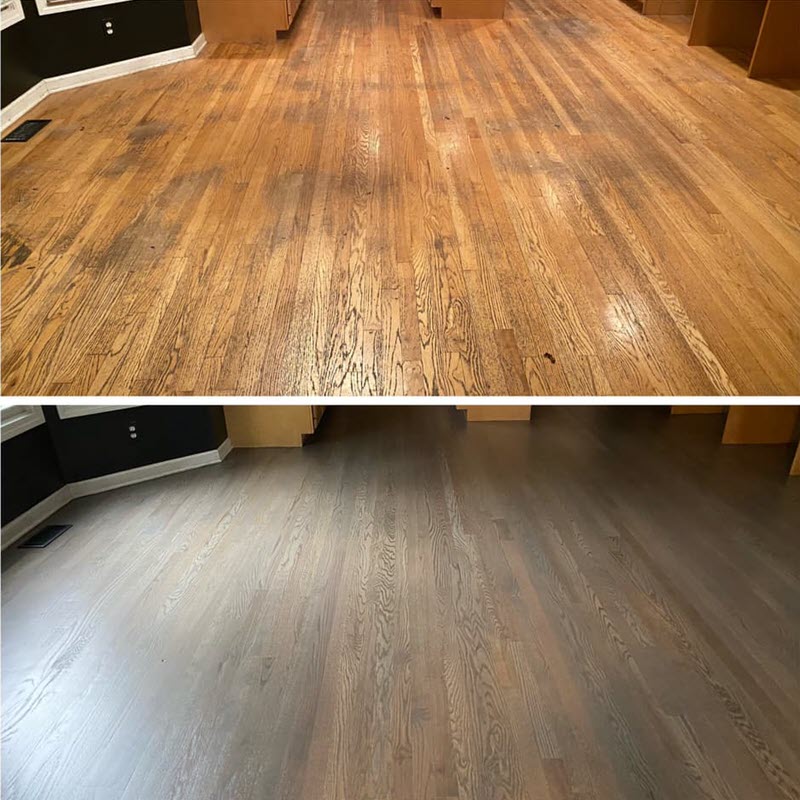
Most solid hardwood floors can be refinished six to eight times over their life, which is why a good solid floor can last as long as the house itself. Engineered wood is a different story: it can be refinished once or twice if its real-wood surface is thick enough, and not at all if it's thin. The number that actually decides it isn't the age of the floor but the wood left on top of it, the wear layer, and that's something you can check. This is everyday work for us, so the hardwood refinishing we do starts with reading that wear layer before we ever put a sander on the floor.
How Many Times Can You Refinish Solid Hardwood?
Solid hardwood can usually be sanded and refinished six to eight times over its service life. A solid board is the same wood top to bottom, milled at a standard 3/4-inch thickness with a tongue-and-groove joint down its edges, and everything above that joint is fair game for a sander. That's a lot of wood: at six to eight full refinishes, a solid oak or maple floor can hold up for the better part of a century, taking a fresh sanding every decade or two as the finish wears and the look dates. This is why solid hardwood keeps its reputation as the floor you refinish rather than replace.
How Many Times Can You Refinish Engineered Hardwood?
Engineered hardwood can be refinished only as many times as its wear layer allows, which for many floors is once, twice, or never. An engineered board is a thin slice of real wood, the wear layer, bonded over a stable plywood or fiberboard core. Sand through that top slice and you hit the core, and the floor's done. The National Wood Flooring Association (NWFA), the trade group that writes the U.S. standards for wood floors, will only certify an engineered floor as refinishable when its wear layer is at least 2.5 millimeters on a factory-finished floor or 3.2 millimeters on an unfinished one, and it says a floor should not be sanded once that layer falls under 2.5 millimeters. A thick 4-to-6-millimeter wear layer has room for a full sanding or two; the paper-thin veneers on many budget floors have none, and can only be recoated or replaced.
Refinishing by Floor Type
Floor type | Wear layer | Full refinishes possible |
|---|---|---|
Solid hardwood (3/4 inch) | Thick, above the tongue | 6 to 8 |
Engineered, thick wear layer (4 to 6 mm) | 4 to 6 mm | 1 to 2 |
Engineered, thin wear layer (under 2.5 mm) | Under 2.5 mm | 0; recoat only |
Laminate or vinyl (wood look) | Printed image, no real wood | 0; cannot be sanded |
What Really Limits the Number: The Wear Layer
The limit on refinishing is the wear layer, the depth of real wood a sander has to work with before it reaches the tongue on a solid floor or the core on an engineered one. Each full sanding removes 1/32 to 1/16 of an inch of wood, roughly 0.8 to 1.6 millimeters, and a heavier cut to level a cupped or deeply scratched floor takes off more. The NWFA draws the line at 3/32 of an inch, about 2.38 millimeters: once the wear layer is thinner than that, sanding risks cutting into the tongue-and-groove and weakening the floor, so a good refinisher stops. Do the arithmetic and the six-to-eight-times figure makes sense; a solid floor simply has that much wood to give, and each refinish spends a small, known slice of it.
Screen-and-Recoat: Refreshing Without Spending Wood
A screen-and-recoat renews a tired finish without sanding down to bare wood, so it does not count against the wear layer at all. Instead of a full sanding, the floor gets a light buff to scuff the old finish, then a fresh top coat over it. It brings back the sheen and the protection, and because it never touches the wood itself, you can screen-and-recoat many times between full refinishes. The catch is that it only refreshes the finish. It can't pull out deep scratches, gray water stains, or a color you've grown tired of, all of which need a full sanding. Used well, a recoat every handful of years can push a real sand-and-refinish out by a decade, which stretches those six to eight sandings across a very long life.
How to Tell How Many Refinishes You Have Left
You can estimate what a floor has left by measuring the wear layer where it is easy to reach. Lift a floor vent or pull a threshold and you can usually see the edge of a board and gauge how much wood sits above the tongue; the more there is, the more sandings you have left. Count the refinishes the floor has already had, if you know them, and watch for the warning signs of a floor near its limit: nail heads starting to show, the tongue peeking through at board edges, or boards that have already been sanded thin and flex underfoot. When a floor is genuinely at the end of its sandable wood, that's the point where replacement starts to beat another refinish, and it's worth having a professional confirm it before you spend on either.
Does the DMV Climate Wear a Floor Out Faster?
The DMV's humidity swing doesn't sand your floor, but it can force heavier refinishes sooner if the indoor climate is left to drift. Wood that cups in a damp summer or gaps in a dry, heated winter often needs a heavier leveling sand to bring it flat again, and a heavier sand spends more of the wear layer than a routine one. The NWFA points homeowners at a steady 60 to 80 degrees and 30 to 50 percent relative humidity for exactly this reason: hold the house there and the boards stay flatter, so refinishes stay light and infrequent. We get into the seasonal cupping and gapping that drives this in more detail, but the short version is that steady indoor humidity is the cheapest way to make a floor's sandings last.
Common Questions About Refinishing Hardwood
How often should hardwood floors be refinished?
Hardwood floors are refinished by wear, not by the calendar, but in a typical home a full sand-and-refinish comes around every decade or two. A busy household with pets may see the finish wear through sooner, while a quiet one can go much longer. Because each solid floor has six to eight full sandings in it, refinishing on wear rather than habit is what makes those last a lifetime.
Can you refinish engineered hardwood?
You can refinish engineered hardwood when its wear layer is thick enough, generally 2.5 millimeters or more. A 4-to-6-millimeter wear layer has room for a full sanding or two; anything under about 2.5 millimeters shouldn't be sanded, and the thinnest veneers can't be refinished at all. If you're not sure how thick yours is, a pro can measure it at a vent or a doorway before you plan any sanding.
What is the difference between screen-and-recoat and full refinishing?
A screen-and-recoat refreshes only the finish, while a full refinishing sands the floor back to bare wood. The recoat is a light buff and a fresh top coat that renews sheen and protection without removing any wood, so it can be repeated often. A full refinishing removes 1/32 to 1/16 inch of wood to erase deep scratches, stains, or an old color, and it is the only one of the two that spends the wear layer.
How do I know if my floor can be refinished again?
Check the wear layer and watch for the signs of a thin floor. If nail heads are showing, the tongue is visible at board edges, or a previous sanding already took the floor thin, it may be at its limit. The reliable test is to measure the remaining wood above the tongue at a vent or threshold, which a refinisher can do in a few minutes and tell you whether another sanding is safe.
Does refinishing make hardwood floors thinner?
Yes. A full refinishing removes 1/32 to 1/16 of an inch of wood each time, which is why there's a limit at all. That's a small amount, and a solid floor has enough wood for six to eight rounds of it, but it isn't infinite. Spacing refinishes out with screen-and-recoats and steady indoor humidity is how you keep from reaching the limit before the floor has given you its full life.
Getting the Most Life Out of Your Floors
How many times you can refinish a floor comes down to the wood on top of it, and the honest way to know yours is to measure it rather than guess. Whether you want a full sand-and-refinish, a quick recoat to buy time, or a straight answer on whether the floor still has sandings left, we can look at what you have and tell you plainly. When you are ready, request a free estimate and we will check the wear layer and walk you through the options.


