

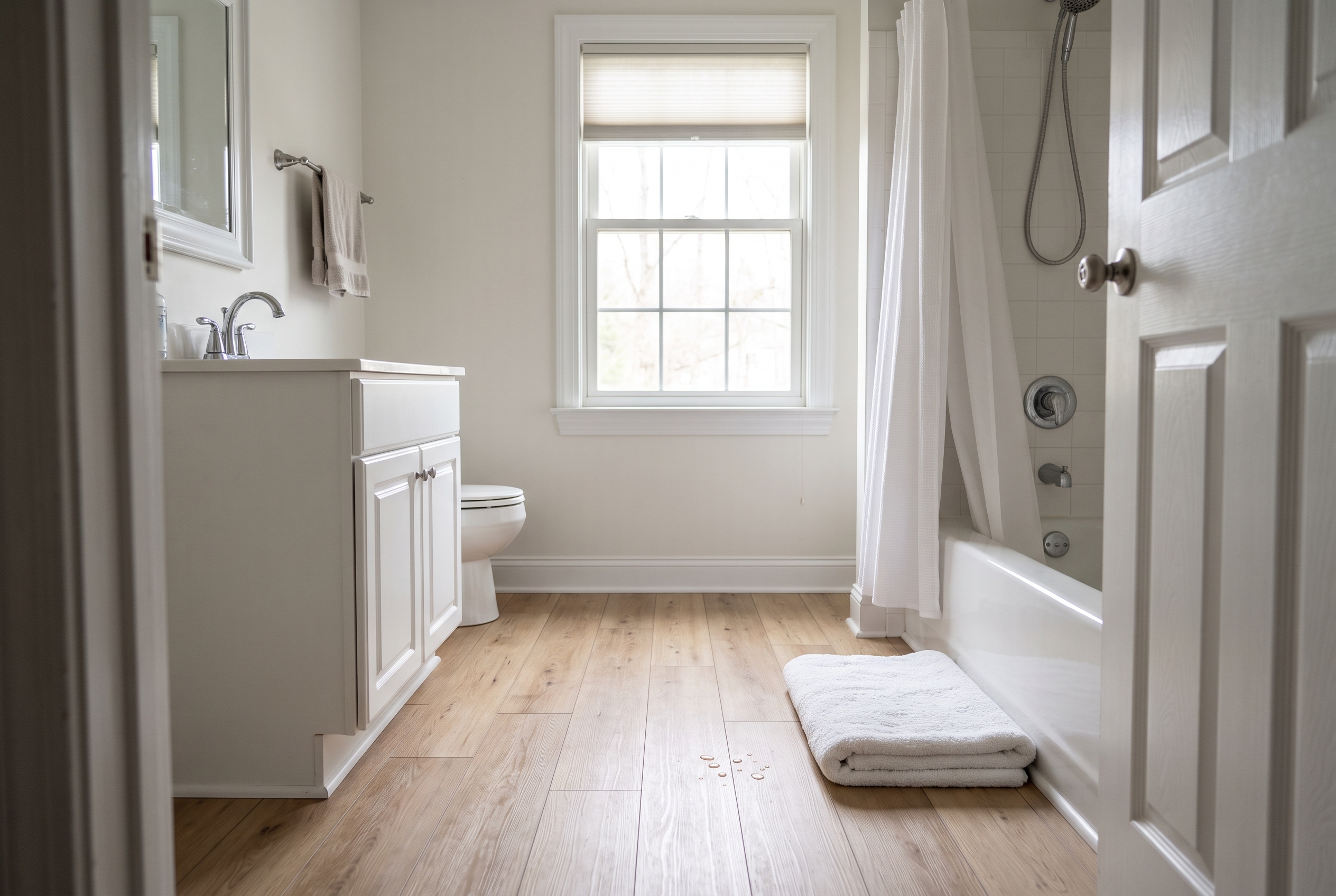
Some laminate is waterproof, and plenty of it isn't. A plank sold as waterproof is built to take spills, wet mopping and the splashes of a kitchen or bath without swelling, as long as the water comes up within the time its paperwork allows. Ordinary laminate needs water wiped up right away, and neither kind is made for a flood, water left standing for days, or moisture rising out of a slab.
| Room | Waterproof Laminate? | What Decides It |
|---|---|---|
| Kitchen | Yes | Slow leaks under the sink and dishwasher |
| Powder room | Yes | Edges sealed the way the maker asks |
| Full bath with a tub | Line by line | The maker's rules for that line |
| Laundry room | Usually | Floor drains rule some lines out |
| Entry or mudroom | Yes | A mat for winter slush and salt |
| Basement | If the slab tests dry | Water coming in is never covered |
Why Water and Ordinary Laminate Don't Mix
Ordinary laminate resists water on its surface and soaks it up at its edges. Every plank is a photographic layer and a clear wear layer over a high-density fiberboard core, and while the top sheds a spill, the core is compressed wood fiber that drinks water in. Water doesn't go through the surface; it finds the seams between planks and the cut edges at the walls.
Once the fiber at a joint takes on water, it swells, and the edges of the two planks rise into a ridge you can feel with your foot. That swelling doesn't settle when the floor dries, and laminate can't be sanded flat the way wood can, so a swollen plank stays swollen until it's replaced.
Water-resistant laminate tightens the joints and seals the top, which gives you time to wipe up a spill before it reaches the core. Waterproof laminate goes further, with joints, edges and surface treatments made to keep water on top for a stated time.
What the Waterproof Label on Laminate Covers
A waterproof label on laminate is a promise about water on the surface, on a floor installed the way the maker says, for a stated length of time. It covers the boiled-over pot, the wet dog, the dripping boots and the mop you actually wet, as long as you clean up within the time the paperwork for your line allows. That clock is real, and leaving water past it is on the owner, not the floor.
What the label never covers is water that floods the room, stands for days, rises from underneath, or runs from a leaking pipe or appliance for weeks. A floor installed without the seals its maker requires can lose its coverage too. The paperwork that comes with your floor is what counts, and we go through it with you before you order.
Water-resistant buys you time, while waterproof means the plank itself won't swell, and that's the line to hold any label against. Waterproof laminate still isn't vinyl, though. Its core is wood fiber with a defense around it, while a vinyl plank's core doesn't absorb water at all, which is why vinyl plank is the more forgiving floor where water lingers.
Which Laminate Floors Are Waterproof
Most of the laminate we sell now carries a water rating, and the word on the carton tells you which kind you're holding. The Water Protection filter in our laminate catalog tags 109 colors across 18 lines as waterproof and only four as water resistant, and some waterproof lines aren't tagged yet.
Two of the makers we carry spell out their wet-room rules in detail. Mannington's Restoration Collection carries SpillShield Plus waterproof technology and is made for kitchens, bathrooms, laundry rooms and mudrooms. Mohawk's RevWood Plus lines, which for us include Adler Creek, Antique Craft, Bellente, Casita Terrace, Castlebriar, Cypresta, Sterlington and Western Row, go in with a watertight silicone seal around the whole room. Lines from Chesapeake, Revolution Mills and Shaw are also among the ones tagged waterproof, so the choice is wide.
| Maker and Line | Built For | The Rule That Keeps It Waterproof |
|---|---|---|
| Mannington Restoration Collection | Kitchens, baths, laundry, mudrooms | Silicone in bath gaps and at the toilet |
| Mohawk RevWood Plus | Indoor rooms, basements included | Silicone around the whole room |
| Other lines tagged waterproof | The rooms on the carton | The installation sheet in the carton |
Whatever the brand, read the carton and spec sheet for the word waterproof or water resistant, the rooms the maker names, the wet-room steps in the installation sheet and the care rules for mopping.
What Waterproof Laminate Costs
Nationally, laminate costs about $3 to $13 a square foot installed, going by HomeAdvisor's survey of more than 10,000 customers' project costs. The typical project in that survey ran about $1,500 to $4,650, with the material about $1 to $6.50 a square foot and the labor about $2 to $8.
The plank moves the price more than the label does. An 8 millimeter plank runs about $1 to $1.80 a square foot of material, while a 12 millimeter plank runs about $2.30 to $6. A texture that follows the printed grain costs more than a smooth one. A 12 x 15 kitchen, 180 square feet, comes to about $540 to $2,340 installed at the national range, before the old floor comes up.
Taking up an old floor adds about $400 to $600 per 200 square feet, and wet rooms add the silicone and trim their installation calls for. We price your rooms when we measure them, because the subfloor and the rooms you pick are what move the number.
Where Waterproof Laminate Works in Your Home
Waterproof laminate is at home wherever the water is the kind you can see and wipe up. A room where water can pool out of sight, rise from underneath or sit for days is the room to think twice about, and every room in the house carries that risk in its own way.
Kitchens
Kitchens are good rooms for waterproof laminate. The spills you see are the easy part. The risk is the slow leak you don't see: a dishwasher supply line, a fridge water line or a sink trap that drips into the cabinet and out under the toe-kick.
Put a battery leak sensor under the sink and behind the dishwasher, and look under the sink every few months. A laminate floor floats, so it stops at the cabinets rather than running under them, which keeps a leak inside a cabinet from soaking under the whole floor.
Bathrooms
For a powder room, a waterproof line is an easy yes. A full bath with a tub or shower is where the makers draw their own lines, so the rules for the line you pick decide it. Mannington names bathrooms for its Restoration Collection and requires the expansion gap, including around the toilet flange, to be filled with 100 percent silicone. Mohawk's RevWood Plus sheet doesn't name rooms but rules out any room with a floor drain.
A walk-in shower floor is never a place for laminate, and a kids' bath where water stands on the floor every night is better in vinyl or tile. In a typical hall bath, a bath mat that dries out, a quick wipe after showers and a sealed perimeter keep a waterproof laminate in its comfort zone.
Laundry Rooms
In a laundry room, waterproof laminate handles drips and spilled detergent. A washer overflow or a burst supply hose is the flood case, and no laminate program covers it. Steel-braided supply hoses, a drain pan with a leak sensor and a shut-off valve you can reach are the low-cost protection.
Look at the floor itself before you pick a line. A lot of DMV basement laundry rooms have a floor drain, and that floor-drain rule takes RevWood Plus off the list there. In a second-floor laundry or a condo, a leak doesn't stop at your floor; it comes through the ceiling of the room underneath, which is one more reason for the drain pan.
Entries and Mudrooms
Entries and mudrooms work in waterproof laminate with a good mat at the door. DMV winters bring slush and road salt in on boots, and the salt's grit scratches the wear layer while the melt pools at the threshold.
Put a rough mat outside the door and an absorbent one inside, keep a boot tray for wet shoes, and wipe up the puddle the same day. Filling the expansion gap at exterior doors with silicone keeps blown-in rain and melt from reaching the edge of the floor.
Basements and Floors on a Slab
A dry basement can take a waterproof laminate that's approved for basements, and the installation sheet says whether yours is. A basement has two kinds of water, though, and they're handled differently. Moisture rising through the slab is handled under the floor, with a vapor barrier and a slab that has been tested. Water that comes in, from a storm, a failed sump pump or a water heater, isn't covered by any laminate program.
Look at the basement's history before you choose. White crust or water lines on the walls, a musty smell, or a sump that runs often all point to a room for vinyl or tile. A dehumidifier through the DMV summer helps any basement floor, and in a house over a crawlspace the moisture control starts in the crawlspace itself. We test the slab for moisture before any new floor goes down, so the plan matches what the concrete actually does.
Homes With Pets
Waterproof laminate is a good floor for homes with pets, for water bowls and the accident you find within the hour. Urine left for days is another matter, because it can still work into the joints and leave an odor, so wipe up every accident as soon as you find it.
Put a mat under the water bowl, check the corners and behind doors where accidents hide, and choose the wear rating for the claws. An AC4 rating is the usual pick for a busy house with dogs.
Installing Laminate So It Stays Waterproof
A waterproof laminate is only waterproof once it's installed the way its maker requires, because the promise is for the finished floor and not the plank in the box. These are the steps the makers' instructions call for in wet rooms:
- Acclimate the cartons in the room, in the temperature and humidity range the instructions give. In a DMV summer that usually means running the air conditioning or a dehumidifier before the floor goes in.
- Flatten the subfloor to within about 3/16 inch over 10 feet.
- Keep the expansion gap at the walls, about 3/8 inch, because a floating floor has to move.
- Seal the gap. Mannington fills the bathroom gap and the toilet flange with 100 percent silicone; Mohawk fills the whole perimeter with foam backer rod and covers it with silicone, never acrylic caulk.
- Run silicone where moldings and transitions touch the floor.
- Stop the floor at cabinets and islands rather than running it under them.
Laminate goes in as part of our residential installation work, and the instructions in the carton for the line you choose are the ones the job follows.
Can You Mop Waterproof Laminate?
Yes, a well wrung-out wet mop is fine on waterproof laminate, and steam is where the makers split. Mannington approves residential steam mops on its Restoration Collection. Mohawk's RevWood Plus instructions call for an occasional wet mop with water only, never leaving puddles, and say nothing about steam, so follow the care page for the line you own.
Plain water does the job, or a cup of vinegar in a gallon of water for a deeper clean. Skip wax, polish and soap, which leave a film that dulls the floor. On ordinary or water-resistant laminate, stick to a dry mop and a barely damp cloth.
What to Do When Water Gets Into Laminate
If water has gotten into your laminate, what you do in the first hour matters more than anything later, because the core keeps swelling for as long as it stays wet. Drying it fast is what decides whether you replace three planks or a whole room. Work through these in order:
- Stop the water: shut the valve, unplug the appliance, or call a plumber for a pipe.
- Soak up what's standing with towels or a wet vacuum.
- Pull the baseboard and the last row of planks near the wet spot so air can reach underneath.
- Run fans and a dehumidifier for several days, and keep the room closed.
Then watch the joints for a few days. Water that stayed on the surface leaves a floor that flattens as it dries. A joint that has peaked, or a plank that has puffed at the edges, has taken water into its core and won't come back down. A musty smell after a week means the subfloor stayed wet.
Swollen planks get replaced, not repaired. Nationally, plank replacement runs about $3 to $11 a square foot, and a typical laminate repair about $385 to $2,100. Once the area is fully dry, swollen planks can usually be lifted out and replaced on their own, as long as a matching plank can be found. If the water reached the subfloor, we repair that first.
A few spare planks from the original cartons make that a quick swap. A burst pipe or an appliance flood is usually a question for your homeowners insurance rather than the floor's warranty, so photograph the damage before anything is torn out.
Waterproof Laminate From Us
At DMV Floor Pros, we carry waterproof laminate from all five of those makers at our Upper Marlboro showroom, alongside Pergo, TRUCOR, Bruce and the other laminate brands we stock. For a full bath, the Restoration Collection is the line whose maker names bathrooms outright.
Seeing a plank in your own kitchen or bath light settles more than a screen does, so we bring samples to your door, and shipping on samples is free. When you're ready, a project specialist meets you to measure the rooms, we test a slab for moisture before any new floor goes down, and we install the floor. If water ever does get under it, we replace the damaged planks and repair the subfloor. Our showroom is at 15207 Marlboro Pike in Upper Marlboro.
Questions About Waterproof Laminate
How Long Can Water Sit on Waterproof Laminate?
Only as long as the paperwork for your line allows, so treat every spill as something to wipe up when you find it. The waterproof time is there for the spill you didn't see right away, not for water left overnight on purpose, and standing water from a leak is outside it however long it sits. After a big spill, dry the joints with a towel and leave the room's fan running.
Can Laminate Go on a Porch or Outdoors?
No. Laminate is made for climate-controlled indoor rooms only, waterproof lines included. A screened porch or a three-season room that isn't heated and cooled sees humidity and temperature swings the planks aren't built for, so it calls for a floor rated for outdoor use.
Can Waterproof Laminate Go Over Bathroom Tile?
Yes, once the grout lines are leveled so the floor sits flat, with the underlayment the maker approves between the tile and the planks. Check the added height at the toilet flange and the door before you commit, and plan for the silicone at the toilet and along the walls.
Does Waterproof Laminate Need a Vapor Barrier on Concrete?
Yes. The waterproof label is about water on the surface, and a slab gives off moisture from underneath. Concrete gets a 6 mil polyethylene sheet with the seams overlapped about 8 inches under the floor, and the installation sheet for your line says whether its own pad replaces that sheet or goes over it.
See Waterproof Laminate in Your Own Rooms
The right waterproof laminate is the one whose rules fit the room you have in mind, and the carton and the installation sheet tell you that before you buy. Pick a few samples for the kitchen, bath or basement, and we'll measure those rooms and price the waterproof line you like.


