

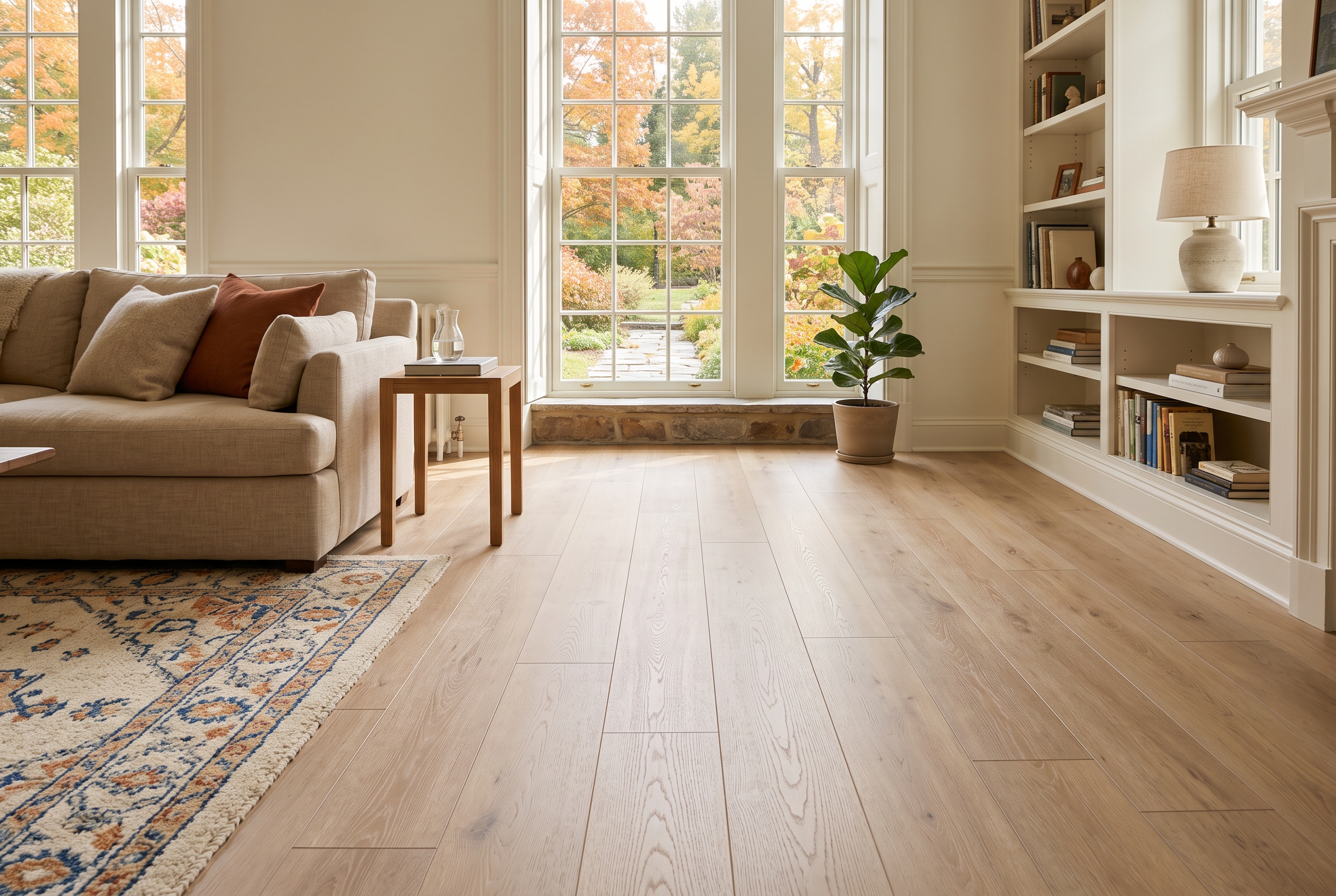
A well-chosen oak laminate passes for a real oak floor from standing height, and it usually costs a good deal less. Nationally, laminate runs about $3 to $13 a square foot installed, against about $7.50 to $18 for oak. Five things decide whether yours will pass: plank variety, texture, sheen, the edges and the way it's laid. Up close, a hand on the surface or the sound of footsteps can still give it away, so aim for a floor that reads as oak across the room.
For the light, natural white oak look, choose a cool visual with an olive or beige cast, mostly straight grain and a matte finish, usually in a wide plank.
Next to red oak floors you already have, aim to coordinate, not match. A warm laminate in the same undertone, meeting the real oak at a doorway, looks intentional. A near-miss laid right against it looks like a mistake.
With dogs and kids in the house, a textured, low-sheen oak laminate hides everyday scratches far better than a smooth, shiny one, and a higher durability rating carries it through busy halls.
Before a sale, a natural or mid-tone oak laminate with a matte finish photographs as a wood floor and suits the widest range of tastes.
On a concrete slab downstairs, oak laminate works once the slab passes its maker's moisture limit and a moisture barrier goes down first.
When the laminate is already down and looks off, the cause is usually how it was laid, and a floating floor can often be taken apart and put right without starting over.
| What to check | Reads as real oak | Gives it away | How to check |
|---|---|---|---|
| Plank variety | Many different plank images | The same knot twice nearby | Lay several full planks in daylight |
| Texture | Grain you feel where you see it | One texture over every design | Fingertip on a knot, side light |
| Sheen | Matte to low satin | Window reflections in the surface | Look toward a window, low angle |
| Edges | Bevels outline each board | One flat, continuous sheet | Run a fingernail across the joint |
| Layout | Long boards, random end joints | Stair-step or lined-up joints | Look down the room from a doorway |
How Laminate Recreates the Look of Real Oak
Oak laminate is a high-resolution photograph of real oak boards, printed on a decor paper and sealed under a clear wear layer on a dense core of compressed wood fiber. The press that bonds those layers also presses a texture into the surface. On the better lines, that texture follows the grain in the picture. For the full breakdown of how laminate is built, from the core to the backing, our laminate guide is worth a read before you shop.
Because the look is printed and pressed at the factory, the choice you make in the sample is the floor you'll live with. Laminate can't be sanded, stained or refinished later to change its color, so there's no fixing a wrong tone after the fact. That's also why two laminates that both say "oak" can look so different: one maker photographed more boards, pressed a deeper texture or chose a flatter finish than the other.
Oak is the wood look you'll see most often in our laminate catalog. It's the floor most of us picture when we think of hardwood, and its open grain gives a laminate plenty of detail to copy, from pale, straight-grained white oak to warm, busy red oak.
What Makes Laminate Look Fake, and How to Check a Sample
Laminate looks fake when your eye catches something a real oak floor never does: the same board twice, a plastic shine, texture that ignores the grain, or edges that turn the floor into one flat sheet. Repeats and shine show from across the room. Texture, edges and sound show up close. Each one has a check you can run on a sample or a few planks before you buy.
How Often the Plank Pattern Repeats
Every laminate line prints a limited set of plank images, and the fewer there are, the sooner the same knot or streak turns up twice in one room. That repeat is the most common reason a laminate floor reads as printed. Counts differ a lot from line to line: Mannington, one of the makers we carry, offers up to 20 unique plank designs in select styles of its Restoration Collection.
A single sample can't show you the repeat, since it's one board. Ask how many different plank designs the line has, then look at several full-length planks side by side in daylight. If you can spot the same knot, dark streak or color patch in two planks out of a handful, a finished room will show it too.
Rustic looks need the most variety, because a distinctive knot is easy to spot the second time. Look at the color spread as well. Real oak changes from board to board, so a line where every plank is the same shade reads as printed. One with some lighter and darker boards reads as wood, as long as those boards are mixed when the floor goes down.
Embossed-in-Register Texture vs. Generic Texture
Embossed-in-register texture, often shortened to EIR, is texture pressed into the laminate so it lines up with the printed grain. You feel a knot, a check or a grain line right where you see one. A generic texture is one grain pattern pressed over every design. It gives the surface some tooth, but it runs across the picture, and in light coming from the side it looks like a coating over a photograph.
To test a sample, run a fingertip along a knot or a dark grain line. With EIR, the dip or ridge is right under your finger. Then hold the sample at eye level near a window and tilt it, and the side light will show whether the texture follows the pattern or ignores it.
EIR planks tend to sit toward the top of a line's price range. For an oak look, they're usually worth it in the rooms people see most. In our laminate catalog, the Surface Texture filter narrows the choice to embossed-in-register planks.
Matte vs. Glossy Laminate
Pick a matte or low-satin oak laminate if you want it to read as wood. Most oak floors finished today have a low sheen that lets the grain show, and that natural, understated look has come back into favor over the last few years. A glossy laminate looks like what it is, a coated image, and it shows scratches, dust and footprints more readily.
To check, look across the sample toward a window from a low angle. If you can see the window reflected in it, it's shinier than most real oak floors. A matte surface also hides the fine scratches that grit and pets leave, which matters more in a family room than in a formal dining room.
Beveled vs. Square-Edge Planks
A beveled plank has a small angled edge along its top, so a shallow groove forms where two planks meet and each board reads on its own, the way real oak boards do. A square-edge plank meets its neighbor flush and reads as one continuous surface, which looks clean and modern but less like separate boards.
A micro-bevel is a small, subtle groove. A painted bevel has the groove colored, which outlines each plank more strongly. For the most convincing oak look, pick a beveled edge, micro or painted, depending on how defined you want the boards to be.
The grooves do collect a little grit, which shapes how you clean the floor. To check a pair of samples, click them together and run a fingernail across the joint; you should feel a soft groove, with no sharp seam or step.
Why Some Laminate Sounds Hollow
Laminate is a floating floor, laid over an underlayment instead of nailed down, so footsteps can sound hollower and more clicky than on nailed oak. How much depends on three things: the underlayment, the flatness of the subfloor and the thickness of the plank.
A good underlayment smooths small bumps in the subfloor, cuts walking noise and makes the floor feel more solid. Some planks come with a pad already attached, and others need one rolled out first. The maker's sheet says which underlayment to use and how thick it can be. Some lines cap the pad at 3 millimeters, because a thick, soft pad lets the locking joints flex, so a denser pad the maker approves is the way to a quieter floor.
The subfloor matters just as much, since planks that flex over a dip click and drum no matter what pad is under them. Thicker planks cost more but absorb sound better and bridge small flaws in the subfloor. In a condo or an upstairs room, check whether the building has sound rules before you pick the underlayment. Underlayment and subfloor repair are both among our services, so the pad and the prep can be planned with the floor.
Red Oak Look or White Oak Look?
Undertone decides between a red oak look and a white oak look, and grain comes second, as long as there are no real wood floors in the house to match. White oak visuals run cool, from pale beige to a gray-beige, with the olive cast of real white oak. Red oak visuals run warm, with its reddish or amber cast. For how the real woods differ, see our guide to choosing between red and white oak.
Arching, cathedral-shaped grain comes from flat-sawn boards and reads traditional. Straight, tight lines and the silvery flecks of quarter-sawn oak read calmer and more modern. Real oak is also graded by character, from clear, with few knots and an even color, down to No. 2 Common, where knots and contrast are the point. Oak laminates copy the same range, from clean, select-style visuals to rustic ones with knots, checks and saw marks.
Pick the tone with the rest of the room in view. Put the samples on the floor, not on a counter, next to the cabinets and trim, and look at them in morning light and again at night under your own lamps. A gray-leaning white oak that looks crisp in a bright showroom can look flat in a north-facing room, and a warm red oak can turn orange next to honey-colored cabinets.
| Oak look | What you see | Pairs well with | Good fit for |
|---|---|---|---|
| Light white oak | Pale, cool cast, straight grain | White trim, black or brass hardware | Bright rooms, modern or coastal style |
| Natural red oak | Warm tan, pink or amber cast | Stained wood trim, cherry or maple | Traditional homes, next to real oak |
| Rustic oak | Knots, checks, color swings | Farmhouse, stone, iron | Busy homes; hides everyday wear |
| Dark or smoked oak | Deep brown, muted grain | Light walls, contrasting trim | Formal rooms; shows dust more |
Plank Width and Length That Read as Real Oak
Match the plank width to the kind of oak floor you're imitating. The wood flooring trade calls boards under 3 inches wide strip, 3 to 5 inches plank, and anything wider wide plank. A narrow board reads as the classic strip floor of an older house, and a wide one reads as a newer, more open look.
In a big, open living area, a wide plank keeps the floor calm and cuts down the number of seams you see. In a small bedroom or a narrow hall, a very wide board can crowd the space. If the laminate will run next to an existing wood floor, pick a width that's either close to it or clearly different, so the change looks deliberate.
Longer planks mean fewer end joints across the room, and fewer joints is what makes a floor look like long boards instead of a patchwork. Some lines come in random lengths or mixed widths, the way a lot of real oak was milled, and our catalog lets you filter for both. Thickness changes the feel and the sound but not the picture, so choose it for the room.
How Installation Makes or Breaks the Hardwood Look
An oak laminate that looks real in the sample can look fake on the floor if it's laid carelessly. The difference comes down to a handful of decisions made before the first plank goes down. The makers we carry agree on the principles and differ on some of the numbers, so the installation sheet for your line is the rulebook.
- Flatten the subfloor. A plank that flexes over a dip clicks, sounds hollow and eventually opens at the joint. Makers allow very little variation, often no more than 1/8 inch over 6 feet, so high spots get ground down and low spots filled before the underlayment goes in.
- Settle the room's climate first. Run the heat or air conditioning for a week before the floor arrives, and keep the humidity between about 35 and 65 percent from then on. That matters here, because DMV summers are muggy, heated winters are dry, and laminate swells and shrinks with the air. The air conditioning or a dehumidifier in summer and a humidifier once the heat comes on hold the range. Most laminate needs no acclimation in normal conditions, but some thinner planks want 48 hours in the room, so check your line.
- Choose the direction. Planks run parallel to the light from the main windows hide their seams in that light, and planks run along the longest wall can make a room look bigger. If the laminate meets an existing oak floor, run it the same way.
- Mix the cartons. Work from several open cartons at once and pull planks from each, so twin planks and patches of one shade never land together. Check each plank in daylight as it goes down. Buy the whole job at once, plus 5 to 10 percent extra, so every plank comes from the same shipment and matches.
- Stagger the end joints at random. End joints in neighboring rows should never line up, and they shouldn't march across the room in a stair-step or repeat every other row. Starting each row with a different length of plank keeps the stagger random. The minimum offset depends on the line: at least 6 inches for some, 12 to 16 inches for others.
- Leave room to move. A floating floor needs an expansion gap at every wall, doorframe and fixed object, from 5/16 to 1/2 inch depending on the maker, and nothing is nailed or screwed through it. Runs past about 50 feet need an expansion break, and a break under the door between rooms is often recommended too. A slim strip under a door looks natural, while one across the middle of an open room doesn't, so plan where they fall.
- Plan the last row. Laying out the room before starting keeps the final row at the far wall more than 2 inches wide, with no thin sliver of plank along the baseboard.
Whoever installs your floor, ask four things before they start. Which way will the planks run, and why? How will they mix the cartons and keep the stagger random? Where will any transition strips go? How will the expansion gap be hidden? Good answers to those four are most of what separates a floor that reads as oak from one that doesn't.
Baseboards, Quarter Round and Doorway Transitions
Every laminate floor needs its expansion gap covered at the walls, and how it's covered changes the look. Pulling the baseboards and resetting them after the floor goes down hides the gap behind the original trim, which looks most like a wood floor that was always there. Leaving the baseboards in place and adding quarter round is quicker, but it adds a visible bead of trim along every wall. The makers allow either approach, and either way the trim is fastened to the wall, never through the floor.
At doorways, the moldings made for your line keep the color and texture consistent. A T-molding joins two floors of the same height. A reducer steps down to a lower floor such as sheet vinyl or thin tile, and an end cap finishes the edge at a sliding door or a hearth. Lay the planks that blend best with each molding right beside it, so the strip melts into the floor.
Can Oak Laminate Go on Stairs?
Yes, oak laminate can go on stairs, using the stair-nose molding made for the line, with each tread and riser fastened down instead of floated. Stairs are the hardest place to keep the hardwood illusion, because the rounded nose of each step is a separate molding, not a solid board. Choose the stair nose with the planks in hand and look at them together in the stairwell's light.
If the stairs already have oak treads, refinishing them in a tone that goes with the new floor can look more natural than covering them. A carpet runner over the treads is the other common answer, and it quiets the stairs as well.
Matching Oak Laminate to the Oak Floors You Already Have
If your house already has oak floors, as a lot of older houses around here do, don't chase a perfect match. A laminate that coordinates and meets the real oak at a doorway looks deliberate. One that almost matches, laid right against the wood, looks like a mistake, because years of finish and light have given the real floor a color no new product has.
The undertone comes first, and the color cast is the quickest tell: red oak leans pink or amber, while white oak leans olive or tan, so stay in the same family. Next, match the character, clean or knotty, and the width. A laminate just a little wider than a narrow strip floor looks like a mismatch, while one clearly wider looks like a choice.
Match the sheen last, since a matte laminate next to a glossy old finish makes both look off. Lay the samples right on the existing floor, in daylight, before you decide, and run the new floor the same direction as the old one. Where the two meet, a T-molding in the doorway gives the eye a clean break.
Sometimes the better answer is real wood. If the existing oak is worn or has turned orange under an old finish, refinishing it, which we also do, changes the color you're matching to and can make coordinating far easier. If the rooms flow into each other with no doorway, extending the real oak may be the only way to make them read as one floor. We install hardwood as well as laminate, so we can price both ways for the same rooms.
How Much You Save With Oak Laminate
Oak laminate usually costs a good deal less than oak hardwood installed, though the two ranges overlap at the top. HomeAdvisor's national survey figures put a 300-square-foot room at about $900 to $3,900 in laminate, installed, and about $2,200 to $5,400 in oak. At the low end of each range, laminate costs less than half as much. At the high end, a top-of-the-line laminate with a lot of prep can cost as much as a basic oak job.
| National figures | Laminate, installed | Oak, installed |
|---|---|---|
| A 300 sq ft room | $900 to $3,900 | $2,200 to $5,400 |
| A 1,000 sq ft main floor | $3,000 to $13,000 | $7,500 to $18,000 |
| Labor per sq ft | $2 to $8 | $3 to $7 |
Labor runs in a similar range for both floors, so most of the saving is in the material. Within laminate, the most realistic planks sit toward the top of the range, since thicker boards, embossed-in-register texture, water-rated cores and attached pads each add to the price. On the oak side, staining unfinished boards on site can add another $3 to $8 a square foot.
Some costs land on either floor. Budget for taking up the old floor, any subfloor repair, the underlayment (about $30 to $60 per 100 square feet for laminate), moldings and transitions, stairs, and the 5 to 10 percent of extra material every job needs. How the two floors compare on durability and at resale is a separate question, and our laminate and hardwood comparison covers it.
Those are national numbers, and your price depends on your rooms. We price it at a free estimate, with the same wholesale pricing we give everyone, not just contractors, and a price match guarantee. Financing is there if you'd rather spread the cost.
Where Oak Laminate Works in a DMV Home
Oak laminate belongs in the dry, lived-in rooms of a house, and the right line reaches into kitchens, baths and lower levels too. The maker's rating for water decides how far. Living rooms, dining rooms, bedrooms and halls suit any oak look, as long as the AC durability rating fits the traffic.
In a kitchen, choose a line its maker sells as waterproof or water-resistant; our catalog's Water Protection filter sorts them. A bathroom is where the maker's rules decide it. Some of the waterproof laminates we carry are approved for baths, with every edge of the floor, including around the toilet, sealed with silicone as the instructions describe. Saunas and steam rooms are off the table for all of them, and where water will stand on the floor, tile or vinyl plank is the safer choice.
A lower level on a concrete slab, which plenty of split-levels and townhomes around here have, can take oak laminate when the slab is dry enough. Each maker sets its own moisture limit for concrete and calls for a moisture barrier under the floor, typically at least a 6-mil plastic sheet unless the underlayment has one built in.
Makers measure their limits one of two ways. One test seals a small dish under a plastic dome on the slab for a few days to catch the moisture rising out of it. The other reads the humidity inside the concrete through a probe set in a drilled hole. Get one of them done before you commit, and if the slab runs damp, vinyl plank is the usual answer.
With pets, a textured, low-sheen oak laminate and an AC4 rating, the usual pick for a busy house with big dogs, do the most. Keep nails trimmed, set the water bowl on a mat, and expect nails to click on any hard floor. A good underlayment softens that sound but doesn't silence it.
If you're selling soon, oak laminate photographs as wood and keeps a listing looking current. Up close it's clearly laminate, and real hardwood still counts for more at resale, so put laminate where it has to work hardest and keep any real oak you already have. If you rent out a property, laminate has another advantage: a damaged plank can often be replaced on its own.
| Room | Oak laminate? | What to pick |
|---|---|---|
| Living, dining, bedrooms | Yes | Any oak look, matched AC rating |
| Halls and entries | Yes | AC4, textured, door mats |
| Kitchen | Yes, water-rated lines | A line sold as waterproof |
| Full bath | Only if the maker approves | Sealed edges; else tile or vinyl |
| Lower level on a slab | If the slab tests dry | Moisture barrier underneath |
| Stairs | Yes, with care | The line's own stair nose |
When Oak Laminate Already Looks Wrong
If a laminate floor that's already down looks off, the cause is usually how it was laid, not the planks, and most of it can be fixed without replacing the floor. A floating floor can be taken apart from the nearest wall and put back together, and many locking systems also let a single plank be swapped out.
| What you see | Likely cause | Fix |
|---|---|---|
| Twin planks side by side | Cartons weren't mixed | Swap planks with ones from elsewhere |
| Joints in a stair-step or grid | Stagger wasn't random | Relay the affected rows |
| Gaps in winter, peaking in summer | Floor pinned or gap too tight | Free the edges; hold humidity steady |
| Hollow or clicking spots | A dip in the subfloor | Lift, level the low spot, relay |
| A chip or deep scratch | Impact or grit | Color-matched filler, or a new plank |
| Dull haze or streaks | Wax, polish or too much water | Stop it; use a laminate cleaner |
Repeats and joint patterns are fixed by taking up the rows involved and relaying them with planks drawn from around the room, which is less work on a floating floor than it sounds. Gaps that open in January and seams that peak in July mean the floor can't move. Usually a molding or transition was fastened through it, a kitchen island was set on top of it, or the expansion gap was too tight. Freeing those edges and holding the humidity in the makers' range usually settles it.
A small chip takes a color-matched filler. A plank with deeper damage is replaced. That's why it pays to keep a few spare planks from the original cartons, wrapped and labeled, in a dry closet, since planks bought years later may not quite match. Flooring repairs are one of our services, so describe what you're seeing when you request an estimate and we'll price the fix.
Keeping Oak Laminate Looking Like Hardwood
Day-to-day care for oak laminate comes down to keeping grit off it and water out of the seams. Dust mop or vacuum often, on the hard-floor setting with no beater bar. When it needs more, use a cloth or mop that's barely damp and a cleaner made for laminate, and wipe up spills and pet accidents right away.
Beveled planks are best cleaned dry, since the grooves hold grit and water. Never wax, polish or oil-soap laminate; all three leave a film that dulls it and looks nothing like a wood finish. Steam is the one point where the makers we carry disagree. Mannington approves residential steam mops on its Restoration laminate, while Shaw and Mohawk say no steam on theirs, so follow the care page for the line you own.
Put felt pads under furniture legs, wide protectors under heavy pieces and soft wheels on rolling chairs. Lay mats inside every outside door, where most of the grit that dulls a floor comes in.
Choosing Oak Laminate With Us
At DMV Floor Pros, we carry oak-look laminate from Mohawk, Pergo, Shaw Floors, Mannington, TRUCOR and Eastern Flooring Products. Online, you can narrow our laminate by wood species, color tone, surface texture, edge profile, gloss level and water protection. Choosing Oak and then a light, medium or dark tone takes you straight to the oak looks.
Samples ship free, and if you'd rather see a range of them in your own rooms, our shop-at-home service starts with a request and a phone consultation, and then we bring samples to your door. You're also welcome at our Upper Marlboro showroom on Marlboro Pike.
Before you request a price, snap a few photos of the rooms and of any wood floors the laminate will meet; they make the questions about direction and transitions quicker to settle. We install what we sell, including the underlayment and any subfloor repair, for homes from Washington, DC, through Prince George's, Charles, Anne Arundel and Montgomery counties, and across the river in Arlington, Alexandria and Fairfax.
Questions People Ask About Oak Laminate
Is Oak Laminate or Oak-Look Vinyl More Realistic?
Oak laminate and oak-look vinyl plank can both look like real oak, and the realism comes from the same things in both: plank variety, texture that follows the grain, a low sheen and good edges. The material matters more for the room than for the look. Laminate has a firm, wood-fiber core and a tough wear layer, and vinyl plank is the one to choose where water can stand. Our guide to LVP vs. laminate for busy homes walks through that choice room by room.
How Can You Tell If a Floor Is Laminate or Hardwood?
You can tell a laminate floor from hardwood by looking at an exposed edge, such as a floor vent cutout, a stair nose or a doorway threshold. Real hardwood shows solid wood, or a wood layer over plywood, all the way through. Laminate shows a thin printed layer over a dense brown fiberboard. On the surface, look for the same plank design repeating, and listen: laminate floating over a pad tends to sound hollower underfoot than nailed wood.
Does Oak Laminate Fade in the Sun?
No, not much. Oak laminate is made to resist fading, which is one place it has an edge over real oak, whose color shifts with sunlight over the years. Blinds or shades on a sunny exposure still protect any floor, and a rug that sits in one spot for years is less of a worry on laminate than on real wood.
Which Brands Make the Most Realistic Oak Laminate?
Brands don't decide realism so much as collections do: every maker of oak laminate has plainer lines and more convincing ones, and even the colors within a line differ. Judge any laminate by its plank variety, texture, sheen and edges, and compare two or three finalists side by side in your own light. In our catalog, filtering oak for embossed-in-register texture and a low gloss level is the quickest way to a shortlist across all the brands we carry.
See Oak Laminate in Your Own Light
The surest way to know whether an oak laminate will pass in your house is to see it there, on your floor, in your light, next to your trim. Order a few samples or book a shop-at-home visit, narrow it to one or two, then request a free estimate and we'll price the floor you picked for your rooms.


