

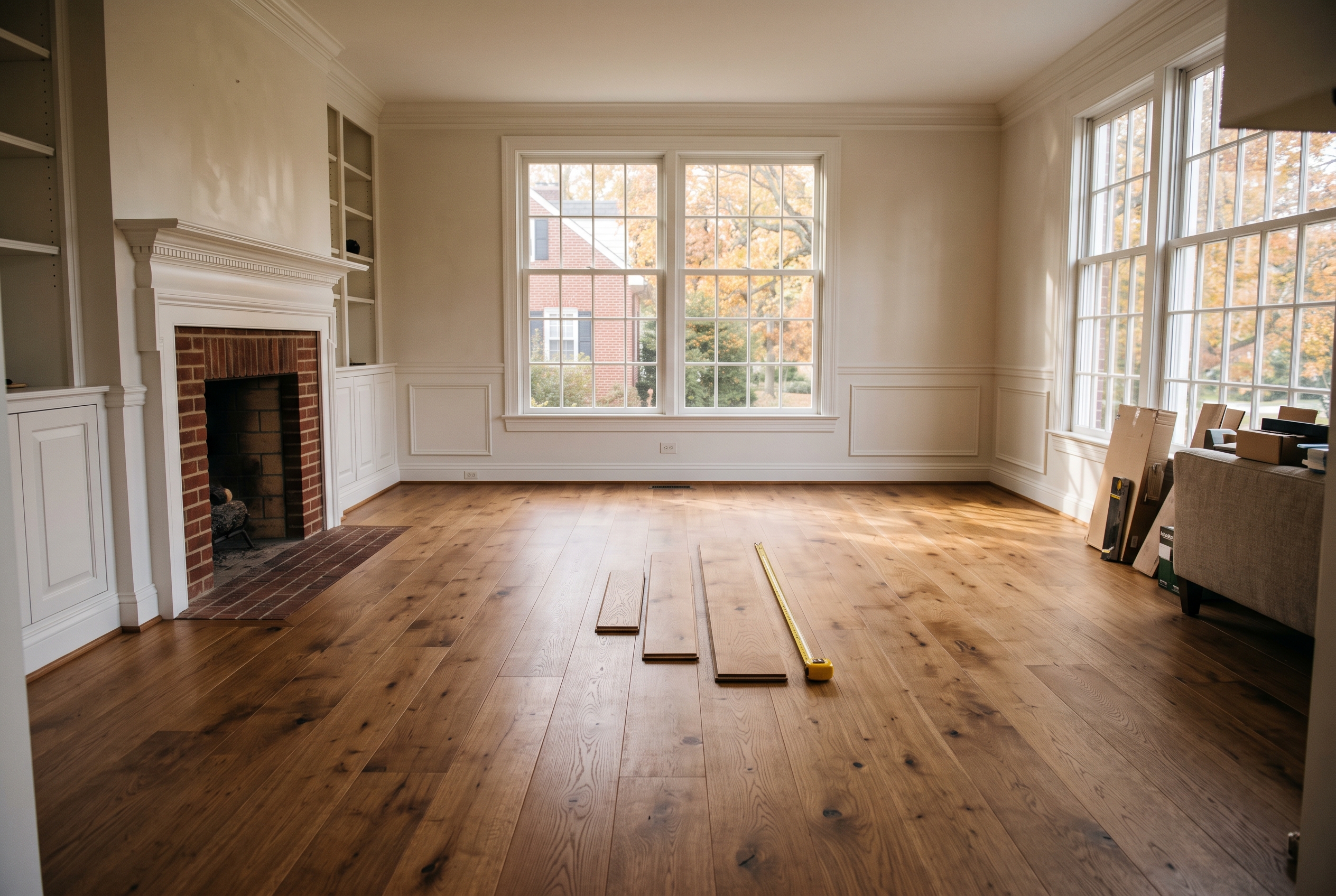
A new hardwood floor costs about $6 to $25 a square foot installed. That's the national range from HomeAdvisor's survey of more than 10,000 customers' project costs, and the typical project in it came in between about $2,500 and $7,000. The wood you choose sets most of the price. The rest is labor and whatever has to come up, or be fixed, before the new floor goes down.
| Space | Size | At $6 to $25 a sq ft |
|---|---|---|
| Bedroom, 12 x 12 | 144 sq ft | About $860 to $3,600 |
| Living room, 14 x 18 | 252 sq ft | About $1,500 to $6,300 |
| Living, dining and hall | 500 sq ft | About $3,000 to $12,500 |
| Most of a main floor | 1,000 sq ft | About $6,000 to $25,000 |
What Goes Into the Price of a Hardwood Floor
Most of what you pay for a hardwood floor is the wood. Installation labor is about $3 to $6 of that $6 to $25 a square foot, so the species, construction, grade and width you pick move the total more than anything that happens on install day. Prep and extras come third, and they're where two quotes for the same floor drift apart.
A clear hardwood quote lists each part of the job on its own line:
- The flooring, priced by the square foot and ordered by the carton, with extra for cuts and waste
- Installation labor, which depends on whether the floor is nailed, glued or floated
- Taking up and hauling away the old floor
- Subfloor work, such as screwing down loose panels, grinding high spots and filling low ones
- What goes under the floor: felt paper for a nailed floor, adhesive for a glued one, a pad for a floating one
- Trim, reducers and thresholds where the new floor meets another one
- Stairs, priced per step
- Sanding and finishing, when the boards arrive unfinished
You'll buy about 10 percent more flooring than the rooms measure, because every row ends in a cut and a few boards get set aside for color or defects. A diagonal or herringbone layout needs more than that. Flooring also comes by the full carton, so the order rounds up again.
When you hold two quotes side by side, check that they price the same square footage and the same lines. A lower total that leaves out removal or the stairs isn't a lower price. Before we price a floor, we measure every room so the square footage on your quote matches the house. Hardwood costs what it does because it's a natural product that's milled, dried, graded and often finished before it reaches you, then fitted board by board.
Hardwood Flooring Cost by Species
Oak is the value end of real hardwood. Red and white oak grow across the eastern U.S., mill cleanly and come in every width and finish, which keeps their price down. Fixr's material-only figures, gathered from pricing databases and contractors, look like this for the species we carry:
| Species | Material per sq ft | What you're paying for |
|---|---|---|
| Red oak | $3 to $5.75 | The classic warm, bold-grained floor |
| White oak | $3.75 to $7 | Calmer grain, cooler color, better with water |
| Hickory | $4.15 to $7.15 | Very hard, lots of color variation |
| Ash | $5.75 to $8.25 | Light, open grain, less common |
| Maple | $6.25 to $10 | Smooth, pale, even grain |
| Walnut | $8.25 to $10.50 | Dark, rich and softer than oak |
White oak usually costs a step more than red, and it earns it. White oak's sealed pores turn spills away, and its cooler tone takes gray and natural stains cleanly. Red oak's warmth suits honey and brown stains, and it stretches a budget across a big main floor.
Hardness and price run on different scales. Maple costs more than hickory, yet hickory is the harder wood, and walnut, the priciest of these, dents more easily than oak. Hickory costs a little more than oak and hides everyday wear well, and pecan, its close cousin, looks and wears much the same. Oak is most of the hardwood we carry, close to 1,000 of the roughly 5,400 colors on our site, followed by hickory, maple, ash, pecan and walnut.
What Solid and Engineered Hardwood Each Cost
If the floor is going over a slab, engineered hardwood is almost always the cheaper job; over plywood, it depends on the board. Nationally, engineered runs about $5 to $20 a square foot installed and solid about $10 to $25. Even so, a wide engineered white oak plank can cost more than a solid red oak strip, because width and species push the price as hard as construction does.
Engineered saves its real money under the floor. Solid hardwood needs a wood subfloor to nail into and doesn't belong below grade, so a solid floor over concrete means building a plywood floor first. Engineered's cross-layered core is what lets it go over a slab or into a basement. It's glued to the concrete or floated over a pad, and on a slab that difference is often bigger than the gap between the boards.
Solid earns back its higher price over the years, because it can be sanded and refinished many times. An engineered floor can only be sanded as often as its top layer of real wood allows, and that wear layer is the price driver inside engineered. Floors certified as refinishable start at a wear layer of about 2.5 millimeters for a factory-finished board. Thinner ones suit a basement or a rental, and thicker ones cost more and behave more like solid.
We carry roughly two and a half engineered colors for every solid one. Bruce's American Treasures is a solid hickory strip and its Brushed Impressions an engineered white oak, so you can compare the two constructions from the same maker. Engineered is also the usual pick over radiant floor heat.
How Grade, Width and Finish Change the Price
Once you've picked a species and a construction, the grade, the plank size, the finish and the pattern still move the material line, sometimes by more than the species did. Each is a look you're choosing, and each has a price.
Clear, Select, Common and Character Grades
A grade sorts boards by how they look, not how strong they are. The NWFA's grading standard says appearance alone sets the grade and every grade is equally strong. Clear grade has almost no knots or color swings and costs the most, and Select adds the natural color difference between heartwood and sapwood. Number 1 and number 2 common bring in knots, mineral streaks and bolder color, and they cost less.
Some of that saving goes back into waste, because lower grades run shorter. The standard's average plank length drops from 36 inches in Clear to 24 inches in number 2 common, and shorter boards mean more joints and more cuts. Character grade, a blend of the common grades, is a look worth choosing for itself, and it hides scratches and dents better than a clear floor. Grade names vary by maker, so the carton or spec sheet tells you what you're looking at.
Plank Width and Length
Wider and longer planks cost more per square foot, because fewer logs yield them. A traditional 2 1/4 inch strip is the budget end, 3 1/4 inch sits in the middle, and planks of 5 inches and wider carry a premium that grows with every inch. Long average lengths read as more natural across a room and cost more too.
Width is easiest to judge on your own floor. Shaw's Albright Oak comes in both 3 1/4 and 5 inch widths of the same oak, so laying one of each side by side shows what width alone does. Wide planks suit long walls and open rooms, while a narrow strip keeps a small bedroom from looking crowded. In the DMV's muggy summers and dry winters, wide boards also move more with the seasons, one more reason most wide planks are engineered.
Prefinished or Finished on Site
Prefinished boards arrive sanded and coated from the factory, so they cost less to install and you can walk on the floor the same day. Unfinished boards cost less to buy, then get sanded, stained and coated in your house, which adds labor and days. HomeAdvisor's survey finds prefinished usually comes out cheaper, while Fixr finds the totals end up almost the same once the site finishing is paid for, so let the finish you want make the choice.
Site finishing earns its cost when you're matching an existing floor, want a custom stain, or want the boards sealed as one flat surface with no bevels between them. For a new floor in a house you're living in, prefinished is quicker and keeps the dust and smell of finishing out of your rooms.
Herringbone, Chevron and Other Patterns
A pattern floor costs more to install and wastes more wood, because every piece is cut and fitted at an angle. Nationally, herringbone runs about $1 to $2 a square foot more than a straight plank layout installed, before the extra waste, and borders and inlays cost more again.
Patterns earn their price where they're the main event: an entry, a dining room, a long hall. Engineered herringbone made in pattern pieces keeps the waste down, and running the pattern in one room while the rooms around it get straight planks keeps the premium to a few hundred square feet.
What Discount and Wholesale Hardwood Really Mean
A discounted hardwood floor is a closeout, surplus stock, a lower grade or an engineered board with a thinner wear layer, and each can be a good buy in the right room. Knowing which you're looking at tells you what to check:
- A closeout or discontinued color. The floor is fine; the risk is running short. Buy enough for every room plus a carton to keep for repairs, because you won't be able to order more.
- Surplus stock, a maker's extra production run of a current floor. Often the best buy of the lot, since nothing about the floor is different.
- A lower grade, such as character or number 2 common. You get more knots and color, shorter boards and more waste, which suits a rustic look and a busy house.
- An engineered floor with a thinner wear layer. It looks the same on day one and can be sanded fewer times, so it suits a basement, a rental or a room you'll redo before it wears through.
"Wholesale" describes the price, not a different floor, so the questions stay the same. Find out the maker and line, the grade, and the wear layer in millimeters if it's engineered. Check how long the boards run, and make sure every carton carries the same lot number on its end label, because two lots of one color can differ. Then open a carton and lay out a few rows on the floor before you commit.
What Hardwood Installation Labor Costs
Installation labor runs about $3 to $6 a square foot nationally, and in a high-cost area like ours, quotes tend to sit toward the top of that range. Engineered and prefinished floors install faster than site-finished or pattern work, and the method matters as much as the material.
Nailing or stapling over plywood is the standard hardwood install. Gluing to a slab takes adhesive and more time, and a floating floor clicks together over a pad and is usually the quickest. Each floor's installation instructions list the methods it allows. A room full of doorways, closets and angles takes longer than an open rectangle, and every stair is hand work.
A good labor line tells you the price per square foot and what it covers, so you can see whether subfloor prep, trim and removal are in it or on lines of their own. When we install hardwood, the job runs in a set order: a consultation and measurement, subfloor preparation, the installation, the trims and moldings that finish the edges, and a final inspection.
The Extras That Add to a Hardwood Job
Removal, subfloor repair and stairs are the extras that move a hardwood quote most, and a single soft spot or a staircase can add more than a step up in species. These national figures show which ones apply to your house before the quote arrives:
| Extra | National figure | When it applies |
|---|---|---|
| Carpet and pad removal | $150 to $250 total | Carpet coming out |
| Old hardwood removal | $2 to $4 per sq ft | Wood coming out |
| Subfloor repair | $900 to $3,000 | Soft, damaged or uneven spots |
| Joist repair | $40 to $60 per sq ft | Structure under the subfloor |
| Stairs | $75 to $200 per stair | Treads, risers and nosing |
Taking Up the Old Floor
Carpet and pad come up cheaply, while tile and glued-down floors cost more to remove because they're broken up and scraped. Before you price anything, lift a corner of the carpet inside a closet or at a floor vent. A lot of DMV colonials, ranches and rowhouses have oak strip under the carpet, and that changes the whole plan.
In an older house, know what's under the carpet before anyone breaks it up. The EPA lists old vinyl floor tile, the backing on old sheet vinyl and the adhesives under them among the building materials that may contain asbestos. Its advice is to leave material in good condition alone and to have a trained, accredited professional take samples before a remodel disturbs it. Testing, and removal if it's needed, become lines on the budget, or the new floor goes over the old one.
Subfloor Repair and Leveling
A sound plywood subfloor needs little more than a few screws and a sweep. Soft spots from an old leak, loose boards in an older plank subfloor and out-of-level floors cost more. Nationally, subfloor repairs run about $900 to $3,000 and joist repairs $40 to $60 a square foot. A nailed hardwood floor wants the subfloor flat to within about a quarter inch over ten feet, so humps are sanded or ground down and dips filled before the first board goes down.
That prep matters here, because DMV houses run from century-old rowhouses to slab-built split-levels, and plenty have had a leak or two. We check and prep the base before any new floor goes down: we secure loose panels, flatten the high and low spots and test for moisture. You can check yours first by laying a long straightedge across the room and looking for daylight under it.
Stairs
Stairs are priced per step, about $75 to $200 a stair nationally, because each tread and riser is measured, cut and fitted by hand. A 13-step staircase in a DMV colonial or townhouse adds about $1,000 to $2,600 to the job, and the nosing at the front of each tread is ordered to match the floor.
If the budget is tight, a common split is hardwood in the rooms and a runner or carpet left on the stairs, with the treads done later. A staircase that already has oak treads under its carpet can often be refinished instead of rebuilt, and refinishing hardwood is part of what we do.
Trim, Transitions and Moving Furniture
A new floor needs base shoe or quarter round along the walls to cover the expansion gap, plus a reducer or threshold wherever it meets tile, carpet or a lower floor. Count your doorways before you compare quotes, because a main floor with a kitchen, a powder room and a carpeted stair can need four or five transitions. We finish every hardwood job with the trims and moldings it needs.
Furniture is the other quiet line, and clearing the rooms yourself before the crew arrives trims labor hours. In a condo, check the board's rules before you order, because many buildings require approval and a sound-rated underlayment under a hard floor.
Sample Hardwood Budgets for DMV Homes
A hardwood budget comes together once you add the extras to the floor itself, so here are three rooms DMV houses actually have, priced with the national figures. They're national ranges, not our prices, and the gap between the low and high end is mostly the wood you pick.
| Project | What's in it | National range |
|---|---|---|
| Bedroom over plywood | 144 sq ft, carpet out | About $1,000 to $3,850 |
| Main floor with stairs | 500 sq ft, carpet out, 13 stairs | About $4,100 to $15,350 |
| Basement on a slab | 600 sq ft engineered, carpet out | About $3,150 to $12,250 |
A Bedroom Over Plywood
A 12 x 12 bedroom is 144 square feet. At $6 to $25 a square foot installed, the floor comes to about $860 to $3,600, and taking up the carpet adds $150 to $250, for roughly $1,000 to $3,850 in all.
Prefinished red oak in a 3 1/4 inch width, nailed over a sound upstairs subfloor, lands near the low end, while a wide white oak plank or walnut pushes it toward the top. Decide whether the closet gets the new floor too, since it adds square feet but saves a transition at the closet door.
A Main Floor With Stairs
The living room, dining room and hall of a typical colonial or townhouse come to about 500 square feet, or $3,000 to $12,500 at the national range. Add carpet removal and 13 stairs at $75 to $200 each, and the job runs about $4,100 to $15,350.
The stairs are the biggest single extra here, so they're the first place to save if you need to. Running one floor through the connected rooms keeps the transitions to the kitchen and powder room, and the same plank across the whole floor makes the rooms read as one.
A Basement on a Slab
A 600 square foot basement gets an engineered floor, glued or floated over the concrete once the slab tests dry. At $5 to $20 a square foot for engineered, the floor comes to $3,000 to $12,000, and carpet removal brings it to about $3,150 to $12,250.
We test the slab for moisture before any new floor goes down, because a slab that tests wet changes the plan before it changes the price. Grinding or patching a slab to get it flat is its own line on top. Before you budget, look for white crust or dark patches on the bare concrete and notice any musty smell, and run a dehumidifier through the summer either way.
Ways to Spend Less on a Hardwood Floor
The biggest saving is a floor you already have. If there's sound oak under your carpet, refinishing it runs about $3 to $8 a square foot in the same survey: $1,500 to $4,000 for 500 square feet, against $3,000 to $12,500 for a new floor. A floor that's flat and sound with wood left to sand is a refinishing job, and we refinish hardwood as well as install it.
For a new floor, these moves cut the price most, roughly in order:
- Choose oak, red or white, in a standard width.
- Take a character or common grade if you like knots and color.
- Go engineered on a slab instead of building a plywood floor for solid.
- Run one floor through the connected rooms to cut transitions and waste.
- Do all the rooms in one project instead of one at a time.
- Clear the furniture yourself before the crew arrives.
- Keep carpet on the stairs for now and add hardwood treads later.
If you want the wood look for much less, laminate gives you a convincing wood floor for a fraction of the price, though it can't be sanded and refinished. And when the right floor costs more than you want to pay at once, you can spread the cost over time through our financing, with a soft credit check that doesn't affect your score.
Is Hardwood Worth the Cost?
Yes, for the rooms you plan to keep, because a hardwood floor gets renewed rather than replaced. A solid floor takes six to eight full sandings over its life, and each one costs about $3 to $8 a square foot, a fraction of the $6 to $25 a new floor runs.
Run the numbers on a 500 square foot main floor kept for 30 years. One installation at $3,000 to $12,500 plus two refinishes at $1,500 to $4,000 each comes to about $6,000 to $20,500, and at the end you still have a wood floor with sandings left in it. Wood floors are also one of the features buyers look for when a house goes on the market.
New hardwood is harder to justify in a house you'll sell within a year or two, a basement that takes on water, or a rental that turns over hard. If you're selling soon and there's oak under the carpet, refinishing it is the stronger move; if there's no wood to refinish, laminate gives listing photos the wood look for much less.
When a Hardwood Job Costs More Than the Quote
If your final bill came in higher than the quote, the reason almost always turned up when the old floor came up. These are the usual causes, roughly in the order we see them, with what each tends to cost and how to get ahead of it:
- Rot or soft spots in the subfloor, usually under a kitchen sink, a bathroom door or an old radiator. Subfloor repair runs about $900 to $3,000 nationally, and pressing on soft spots with your heel before the job starts finds most of it.
- Damage that reaches the joists, at $40 to $60 a square foot. A floor that bounces across the whole room is the warning.
- A slab that tests wet. It means a moisture barrier, a different install method or a different floor, and testing before you order the wood keeps you from paying for flooring you can't use.
- Floors out of level, common in older houses. Grinding and patching are priced on what the floor needs, and a straightedge across the room before the quote shows you the worst of it.
- Old tile or sheet flooring that needs testing for asbestos before it's disturbed.
- Changes mid-job, such as adding a closet, a stair or another room. Settle the room list before the wood is ordered.
The other surprise is a floor that's already down and misbehaving. Winter gaps that close again by summer are the wood moving with the season, and they cost nothing to fix. Cupped boards, gaps that stay open and loud squeaks point to moisture or loose fasteners, and swapping damaged boards and resetting loose ones is repair work, far cheaper than a new floor.
Choosing Your Hardwood With Us
At DMV Floor Pros, we sell and install solid and engineered hardwood from our Upper Marlboro showroom. We carry more than 400 hardwood floors from about two dozen makers, including Bruce, Shaw, Mohawk, Hartco, Mullican, Chesapeake and Anderson Tuftex, in oak, hickory, maple, ash, pecan and walnut.
Wood looks different in your own light than on a screen, which is why we bring samples to your door, and shipping on samples is free. When you're ready, a project specialist meets you to measure your rooms and talk through the floor you have in mind. We install the floor, finish the edges, and can refinish it for you years from now. Our showroom is at 15207 Marlboro Pike in Upper Marlboro.
Hardwood Flooring Cost Questions
Can I Save Money by Installing Hardwood Myself?
Yes, installing hardwood yourself saves the labor, which is about $3 to $6 a square foot, if you have the tools and the patience. Nailing hardwood takes a flooring nailer, a miter saw and a lot of kneeling, and a mistake in the layout or the expansion gap shows for the life of the floor. A floating engineered floor is the friendliest choice for a first job, because it clicks together over a pad.
Can Hardwood Go Over My Old Floor?
Yes, in some cases: a floating engineered floor can go over flat, sound vinyl or tile, which saves the removal cost and the mess. Carpet always comes out, and anything soft, loose or uneven comes up first. Check the added height too, because the new floor has to clear doors, appliances and the top stair.
How Long Does a Hardwood Installation Take?
Plan on three to seven days before the installation starts. Hardwood usually sits in your home that long to acclimate before the first board goes down. After that, a site-finished floor needs several more days for sanding and coats to dry, while a prefinished floor can be walked on the day it's done.
Does Hardwood Cost More in a Kitchen?
Yes, a kitchen costs a little more per square foot, because it has more cuts around cabinets and an island and more transitions to tile or a dining room. White oak is the better species there for the way it handles spills, and a washable mat at the sink and dishwasher does more for the floor than any finish.
Should I Keep Extra Boards?
Yes. Keep a full carton from the same lot, stored flat in a dry closet. If a board is ever damaged, a match from your own stock is a quick swap, while a discontinued color can be impossible to find a few years on.
Get Your Rooms Measured and Priced
The national ranges tell you what's reasonable, and your own price is set by your rooms, your subfloor and the floor you fall for. Pick a few samples you like and tell us which rooms you're doing, and we'll measure your rooms and price the floor you choose.


